What Does a 1st AD Do? (The Person Who Actually Runs Your Set)
The 1st assistant director builds the schedule, runs the floor, and owns safety — here's what that job looks like hour by hour.
What Does a 1st AD Do? (The Person Who Actually Runs Your Set)
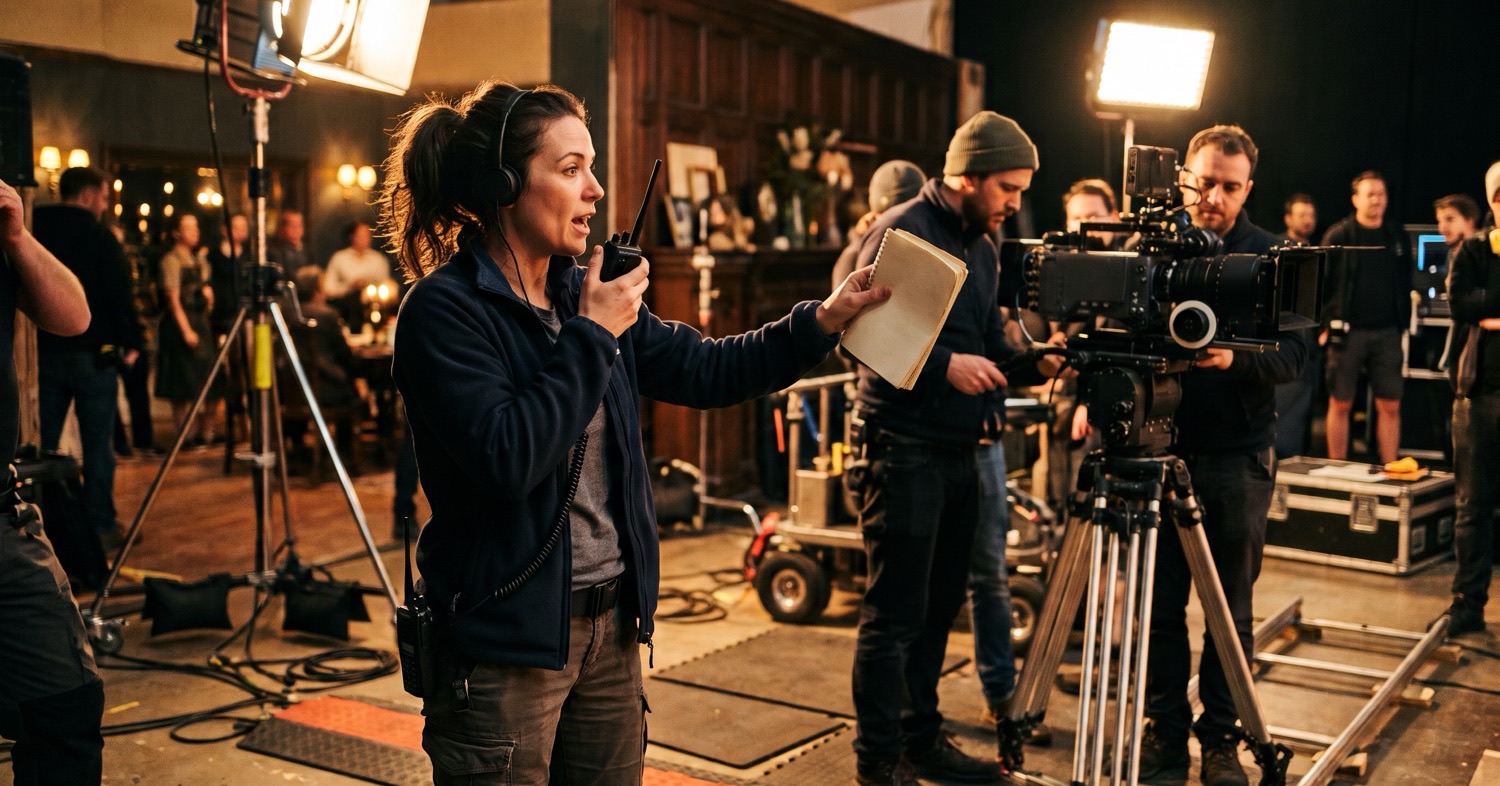
The 1st assistant director (1st AD) is the person who turns a script into a working shoot schedule and then runs the floor on every shoot day to keep the production on that schedule. The director owns the creative call; the 1st AD owns the clock, the crowd, and the safety of everyone standing in front of and behind the camera. If you've ever heard someone yell "settle please" or "we're moving on," that's the 1st AD's voice.
It's a job most people outside production don't fully understand, because a good 1st AD is mostly invisible — the shoot just works. A bad or absent one shows up immediately as chaos: late company moves, confused crew, an unhappy cast, and days that blow their schedule by hours.
Prep: building the schedule before anyone shows up
Before a single frame is shot, the 1st AD builds the stripboard — the master schedule that orders every scene into shoot days based on location, cast availability, time of day, and company moves. This is a genuinely technical skill: getting it wrong means overtime, missed daylight, or a scene shot without an actor who was needed for it.
From the stripboard, the 1st AD (often with the 2nd AD) generates the day out of days for payroll and cast tracking, and a one-liner schedule for anyone who needs the shoot at a glance without the full operational detail. All three documents come from the same source — change the stripboard, regenerate the rest.
The 1st AD also runs the tone meeting, walks locations with the location manager, and negotiates with department heads over how much time each setup realistically needs. This is where an experienced 1st AD earns their rate: knowing that a five-page dialogue scene with three actors takes longer than the page count suggests, or that a night exterior needs an extra hour of prep that isn't in anyone else's estimate.
On set: running the day
On a shoot day, the 1st AD:
- Calls the roll — what time crew, cast, and each department needs to be ready.
- Runs rehearsal-to-shoot transitions ("picture's up," "rolling," "cut").
- Manages background and crowd through the 2nd AD and 2nd 2nd AD.
- Tracks the schedule in real time against the call sheet and decides what to cut, combine, or push if the day is falling behind.
- Owns set safety — stunts, weapons, minors, weather, anything that could hurt someone.
- Calls the wrap.
That last point — safety — is not a footnote. On a union set, the 1st AD is legally and contractually the person responsible for a safe working environment; on a non-union indie set, the responsibility is the same even without the paperwork behind it. A 1st AD who lets an unsafe rig go up because the schedule is tight is doing the job wrong, full stop.
1st AD vs 2nd AD vs 2nd 2nd AD
| Role | Focus |
|---|---|
| 1st AD | Schedule, set floor, safety, pace of the day |
| 2nd AD | Cast management, next-day call sheet, background coordination |
| 2nd 2nd AD | Background/crowd on larger shoots, frees the 2nd AD for cast |
The 1st AD is the only one of the three who's on the floor calling the shots minute to minute. The 2nd AD works adjacent to set (basecamp, holding, the cast trailers) and hands the 1st AD a clean set of ready actors.
1st AD vs line producer vs UPM
People conflate these because all three carry authority over the day, but the split is clean: the line producer owns the budget, the UPM owns production logistics, and the 1st AD owns the schedule and the floor. A good 1st AD flags to the line producer when staying on schedule is going to cost money (overtime, an extra day); the line producer decides whether to spend it or cut scope. Neither one overrides the other's lane on a well-run set.
What makes a good 1st AD
Three things separate a strong 1st AD from a weak one:
Realistic scheduling. Overestimating what a day can hold is the single most common 1st AD failure. A schedule that looks efficient on paper but ignores turnaround time, company moves, and meal breaks will blow up on day one.
Calm authority. The floor takes its energy from the 1st AD. A 1st AD who panics when the day goes sideways spreads that panic to sixty other people standing around holding gear.
Knowing when to push back. Directors ask for one more take; producers ask to cut a company move. A good 1st AD tells both of them, clearly, what it costs — in minutes, dollars, or safety margin — and lets them make an informed call.
New crew members working under a 1st AD for the first time should also get comfortable with basic set etiquette fast — radio discipline, eyeline crossing, and knowing where to stand are the fastest ways to earn (or lose) a 1st AD's trust.
Where the schedule lives
None of the above works if the schedule is stuck in one person's head or a scattered stack of printouts. Production Slate's schedule feature builds the stripboard, DOOD, and call sheets from the same source data, so when the 1st AD moves a scene, everyone downstream — cast, crew, payroll — sees the update instead of working off yesterday's version.
Written by Production Slate · Production Slate