What Is a One-Liner Schedule? (And When to Use One)
The stripboard's leaner cousin — when a one-liner is the right tool for the job.
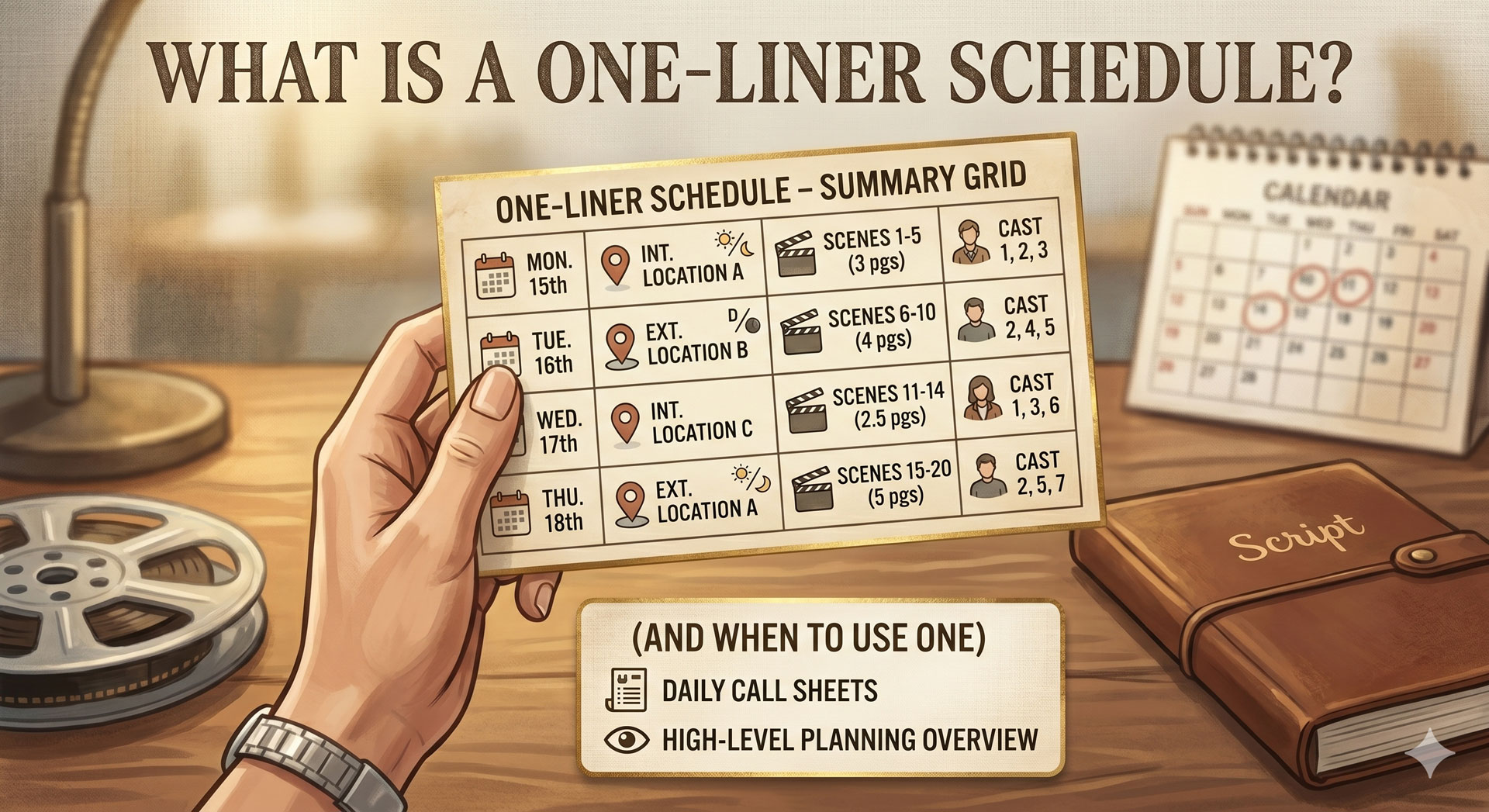
What Is a One-Liner Schedule? (And When to Use One)
A one-liner schedule is a shooting schedule compressed so each scene takes one row instead of a full strip. It carries the essentials — scene number, location, time-of-day, page count, and a one-line description — and strips out the detail (cast IDs, special notes, full strip color codes) that a full stripboard includes. One-liners exist because a stripboard is sometimes too dense for the audience looking at it.
The document is a derivative of the stripboard, not a replacement for it. The 1st AD still builds and maintains the stripboard; the one-liner is what gets handed to the director before a location scout.
The 50-word definition
A one-liner is a condensed shooting schedule where each scene occupies a single row with scene number, location, day/night, page count, and a one-line description. It's derived from the stripboard and used for quick reference by directors, location scouts, and visiting department heads who need the schedule without the operational detail.
What's on a one-liner
A typical one-liner row:
Day  Scene  D/N  I/E  Pages   Location      Description
4    47     D    E    1 4/8   CITY PARK     Lead confronts antagonist near fountain.
4    48     D    E    2/8     CITY PARK     Bystanders react.
4    51     D    E    3 1/8   CITY PARK     Chase begins, lead pursues into side street.
That's it. No cast IDs, no stunt notes, no equipment holds, no banners. The one-liner's whole purpose is readability — someone glancing at it should know, in seconds, what's happening on that day.
When to use a one-liner
Three situations where a one-liner beats a full stripboard:
Director meetings during prep. A director prepping for a meeting with the DP, production designer, or VFX supervisor wants to walk through the shoot without the noise of cast IDs and strip codes. A one-liner on a single sheet of paper answers "what are we shooting when" without the logistical overhead.
Location scouts. On scout day, the location manager, director, and DP are walking the location and checking each scene against the physical space. They need the scene list per day, in shooting order. A full stripboard is overkill; a one-liner prints cleanly on a clipboard.
Visiting heads of department. Production designers, VFX supervisors, costume designers, and composers join the production partway through prep. A one-liner is the fastest way to orient them to the schedule before they dive into their own departmental prep.
The common thread: the audience doesn't need the operational detail. Anyone on the AD team or UPM's desk reads the full stripboard; anyone else usually reads the one-liner.
When NOT to use a one-liner
A one-liner is not the source of truth. Mistakes happen when producers or ADs edit the one-liner and assume the stripboard will update. It won't — the stripboard is the primary document and the one-liner is a view of it.
The rule: always edit the stripboard. Regenerate the one-liner after each stripboard change. If your tool doesn't support one-liner generation, export the schedule as text and manually compress.
Do not:
- Use the one-liner as the working schedule during the shoot — it's missing too much information for set-day decisions.
- Share the one-liner with cast or payroll — the DOOD is the cast-facing document, not the one-liner.
- Build the schedule directly as a one-liner — start with the stripboard, compress after.
One-liner vs stripboard vs DOOD vs call sheet
Four related documents with different scopes and audiences:
| Document | Scope | Audience | Source of truth? |
|---|---|---|---|
| Stripboard | Whole shoot | 1st AD, UPM, production office | Yes — primary document |
| One-liner | Whole shoot | Director, HODs, scouts, press | No — derived |
| DOOD | Whole shoot | Producers, payroll, 1st AD | No — derived |
| Call sheet | One day | Everyone on set that day | No — derived |
All three derived documents (one-liner, DOOD, call sheet) pull from the stripboard. Lock the stripboard, regenerate the downstream documents.
For more on the stripboard itself, see what is a stripboard in film. For DOODs, what is a day out of days. For call sheets, what is a call sheet.
How to generate a one-liner
Two paths:
Manual compression. Open the stripboard, list each scene on a single row, strip out the detail. Fastest for short shoots (under 5 days). Keep the source format consistent so department heads can scan vertically.
Software generation. Some scheduling tools generate one-liner exports automatically from the locked stripboard. Movie Magic Scheduling has long supported this as a standard report. Other tools either have one-liner exports built-in or don't.
A transparency note: Production Slate's schedule feature builds and maintains the stripboard, DOOD, and call sheets from your broken-down script. A dedicated one-liner view isn't currently one of the built-in exports, so if you need a one-liner inside Production Slate, generate it from the schedule by manual compression — copy the scene list, drop the detail columns, and paste into a clean document. Adding a native one-liner export is on our roadmap.
A copy-paste one-liner layout
If you need to build one manually, here's a clean starter format:
-----------------------------------------------------------
[PRODUCTION TITLE] — ONE-LINER SCHEDULE
Version: v1   ·   Derived from stripboard: [YYYY-MM-DD]
-----------------------------------------------------------

Day 1 — [DATE] — [Location group]
 Sc 14  D I  1 2/8  CAFE         Lead orders coffee.
 Sc 22  D I  5/8    CAFE         Lead returns for closure.
 Sc 78  N I  1 4/8  CAFE         Last customer leaves.

Day 2 — [DATE] — [Location group]
 Sc 15  D E  2/8    STREET       Lead walks to work.
 Sc 31  D E  2 6/8  STREET       Confrontation.
 Sc 56  N E  3 2/8  STREET       Chase sequence.

Day 3 — [DATE] — [Location group]
 Sc 42  D I  1 5/8  OFFICE       Meeting with boss.
 Sc 43  D I  4/8    OFFICE       Quiet beat after meeting.
 Sc 89  N I  2 1/8  OFFICE       Late-night phone call.

[continue for each shoot day...]
-----------------------------------------------------------
Paste into Google Docs or print for scout day. One page per 10 shoot days is typical.
Common misconceptions
A few things newer ADs get wrong about one-liners:
It's not a "simple schedule." A one-liner is a compressed schedule. The underlying document (the stripboard) still has to exist with all its detail. The one-liner just hides most of it.
It's not the same as a shooting schedule. A shooting schedule is the textual version of the stripboard with full detail — cast IDs, page counts, special notes. A one-liner is even leaner than that.
It's not for payroll. Payroll services want the DOOD. A one-liner has no cast tracking.
It's not a "final" document. The one-liner regenerates every time the stripboard changes. Treat it as a live snapshot, not a locked artifact.
Next step
If you're planning a director meeting or a location scout, generate a one-liner from your current stripboard and print it on one sheet per 10 days. If you haven't built the stripboard yet, start with how to make a stripboard — the one-liner falls out of that process. For a free starting schedule layout that can double as a one-liner basis, our shooting schedule template is a copy-paste stripboard that you can easily compress. For scheduling software that generates the underlying stripboard from your script automatically, Production Slate's schedule feature is the fastest way in.
Written by Production Slate · Production Slate