What Is a Call Sheet? (And Why Every Film Shoot Needs One)
The daily briefing every film crew runs on. Here's what a call sheet is, who writes it, and why it makes or breaks a shoot day.
What Is a Call Sheet? (And Why Every Film Shoot Needs One)
A call sheet is the single-page document that tells every cast and crew member exactly where to be, when, and what they're doing on a given shoot day. It goes out the night before, it's read at breakfast, and it's the reason the shoot actually starts on time.
If you've never made one, the rest of this post walks through what's on it, who writes it, and when you'll be glad you didn't skip it.
The 50-word definition
A call sheet is the daily production plan for a film or video shoot. It lists crew call times, cast call times, location, weather, scenes being shot, hospital, parking, walkie channels, and safety notes. It goes out the night before the shoot day and is the working document for everyone on set.
What's on a call sheet
Every call sheet has the same core blocks, more or less in this order.
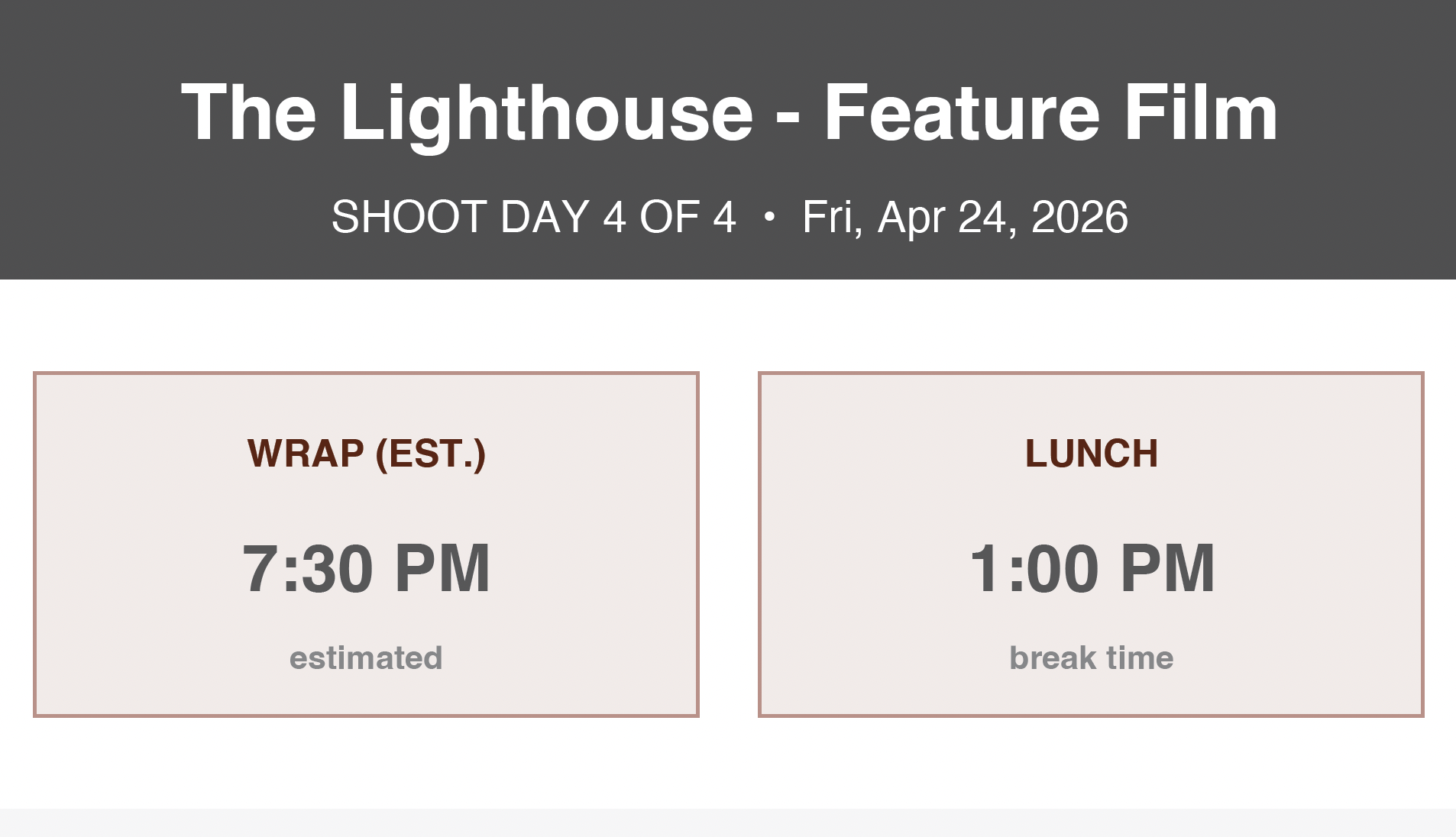
Production info — project title, shoot day number (e.g. "Day 4 of 18"), date, director, producer, 1st AD, weather, sunrise, sunset.
Location — address, parking instructions, hospital name and address, basecamp (where holding, catering, and trailers live).
Schedule — scenes being shot today, in shooting order. Usually with scene number, page count in eighths, a one-line description, cast involved, and any special notes (SFX, stunts, a crane, etc.).
Crew call times — each department with its own call time. Camera, G&E, sound, wardrobe, hair, makeup, art, production, locations, catering. Most call the same time; some (hair/makeup) call earlier.
Cast call times — often different from crew, with separate pickup, hair/makeup, and set call. Cast also get a separate version called a talent sheet with only their info.
Notes and safety — anything that affects the day: weather hold plan, rain cover location, closed-set rules, firearm protocols, COVID protocols if relevant.
Advance schedule — tomorrow's plan, short version. Helps crew plan childcare, commutes, and the after-wrap beer.
If any of these are missing, someone will call the 1st AD at 5:30 AM to ask about it. Don't leave anything missing.
Call sheet vs shooting schedule vs one-liner
These three documents get confused constantly. Here's the short version:
| Document | Scope | When it's made | Who uses it |
|---|---|---|---|
| Shooting schedule | Whole shoot | During prep | Producers, ADs, UPM |
| One-liner | Whole shoot, condensed | During prep | Directors, scouts, press |
| Call sheet | One day | Night before | Everyone |
A shooting schedule and a one-liner answer "what are we doing across the whole production?" A call sheet answers "what are we doing tomorrow?"
Who writes the call sheet
The 1st AD. Always. In practice a 2nd AD or production coordinator often drafts it, the 1st AD revises, the UPM or producer approves, and it goes out.
On a tight indie where the 1st AD is also the director's right hand, the production coordinator might fully own the document and the 1st AD just approves. That's fine — the important thing is one person is responsible and the sign-off chain is clear.
Who receives it
Everyone on the call sheet. That's every crew member working that day, every cast member working that day, and usually a handful of above-the-line producers and department heads not working that specific day who still need visibility.
On a studio show, distribution is internal only — no press, no cast who aren't working. On indie shoots the discipline is looser but the principle holds: if you're not working tomorrow and don't need to know, you don't need a call sheet.
When it's sent
The night before the shoot day. The target most 1st ADs shoot for is 7–9 PM the night before, which gives crew enough time to read it before bed but isn't so early that a late schedule change (location fell through, weather moved) forces a republish.
Anything after 10 PM the night before is considered late. Anything the morning of is a fire drill. If you're planning your first shoot, calendar backwards from wrap-plus-three-hours and you'll hit the window every time.
What happens when it's wrong
Everything. Wrong hospital means the on-set medic can't route an ambulance. Wrong call time means crew show up late or wait three hours on the clock. Wrong location means a van of extras ends up in the wrong carpark at 5 AM. Wrong parking instructions means your location agreement gets yanked when neighbors call the council.
This is why most professional productions have moved to digital call sheets with delivery tracking — you want to know which crew members have actually opened the thing, not guess.
Next steps
If you're making your first call sheet, start with our free template and follow the step-by-step guide. If you're making your hundredth and the spreadsheet version is starting to bite, Production Slate auto-builds call sheets from your schedule and tracks which crew members have acknowledged receipt.
Written by Production Slate · Production Slate