How to Make a Call Sheet (Step-by-Step + Template)
Step-by-step walkthrough of building a pro call sheet, with a free template, a filled example, and the modern workflow crews actually prefer.
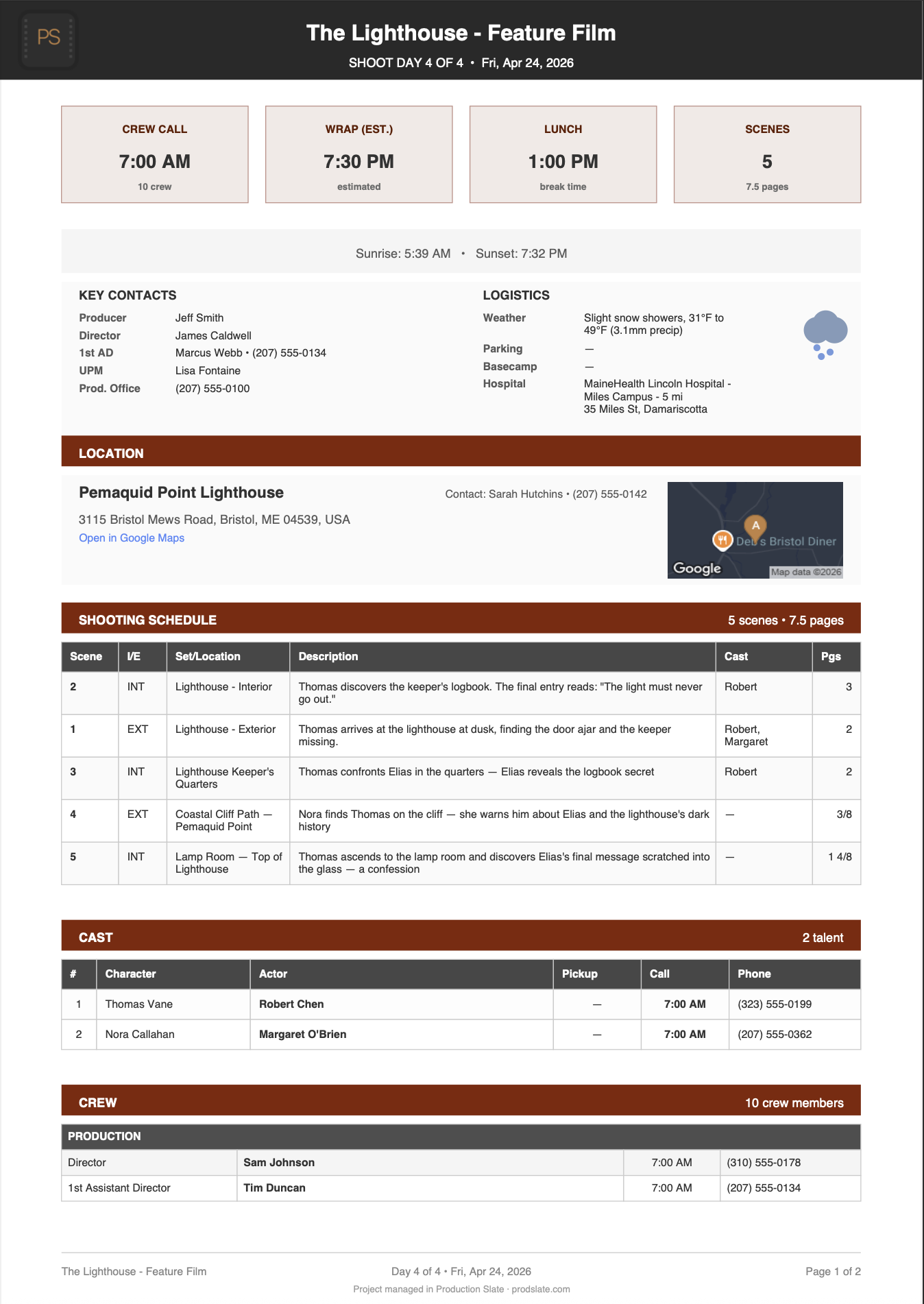
How to Make a Call Sheet in 2026 (Step-by-Step + Free Template)
To make a call sheet, you pull crew and cast call times from your schedule, add the location, weather, hospital, and safety info, lay it on a single page, and send it to everyone working tomorrow — the night before. This guide walks through the whole process, shows what belongs in each block, and links to a free template you can use tonight.
The way call sheets get built hasn't really changed in fifty years. The tools have — most productions have moved from paper and PDF attachments to digital call sheets with delivery tracking — but the information on the page and the order you assemble it in is identical to what a 1st AD would have done in 1975.
The 50-word definition
A call sheet is the single-page daily plan for a film or video shoot. It lists crew call times, cast call times, location, weather, scenes being shot, hospital, parking, and safety notes. It goes out the night before and is the working document every cast and crew member reads at breakfast.
For more on what a call sheet is and where it fits between a shooting schedule and a one-liner, see the full glossary post on call sheets.
The 12 sections every call sheet needs
Every professional call sheet hits these twelve blocks, in roughly this order. Leave one out and someone will call the 1st AD at 5:30 AM asking about it.
Production info — project title, shoot day (e.g. "Day 7 of 22"), date, director, producer, 1st AD, UPM.
Weather and times — forecast, sunrise, sunset, first light, last light, temperature range. Pull the forecast as of roughly 6 PM the night before; if it shifts dramatically overnight, the 1st AD calls affected departments directly rather than re-sending.
Location — full address, parking instructions, hospital name and address, basecamp (where holding, catering, and trailers live), nearest fuel station.
Schedule — scenes being shot, in shooting order. Scene number, page count in eighths, one-line description, cast involved, and any special notes (SFX, stunts, crane, high voltage).
Crew call times — each department with its own call time. Camera, G&E, sound, wardrobe, hair, makeup, art, production, locations, catering, transport. Some departments call earlier (hair/makeup), some later (post-set dressing).
Cast call times — often on a separate talent sheet with only their info. Pickup, hair/makeup, wardrobe, on-set call.
Advance schedule — a short preview of tomorrow's plan so crew can plan childcare, commutes, and the after-wrap beer.
Walkie channels — which channel each department rides on. Usually 1 for production, 2 for camera, 3 for G&E, 4 for sound, 5 for art, 6 for wardrobe, 7 for hair/makeup, 8 for transport.
Safety notes — anything that affects the day. Firearm protocols, stunts, working at height, hot sets, closed sets, any hazardous materials.
Weather plan — what happens if it rains. Cover location, shift to interior scenes, or weather hold start time.
Emergency contacts — nearest hospital, production medic, on-call producer.
Day's notes — anything that doesn't fit the other boxes. Neighbor sensitivities, cable laying, crane moves through public areas.
These twelve cover roughly 95% of what any shoot needs. On stunt-heavy or period productions you'll add more; on a two-person music video you can compress, but the pieces are the same.
How to make a call sheet, step by step
Below is the order a working 1st AD actually assembles the document in. Follow it in sequence — jumping ahead is how errors creep in.
Step 1: Collect the data
You can't write a call sheet until the day is locked. That means the 1st AD and UPM have agreed on what you're shooting tomorrow and in what order, the crew list is current, and the location is confirmed in writing.
Walk through this list before opening the template:
- Tomorrow's date, and whether it's a weekend (affects union multipliers)
- Today's shoot day number vs the total
- The exact scenes, in shooting order
- The current crew list with correct phone numbers
- The confirmed location address and permit status
- The nearest hospital — the one the on-set medic has confirmed, not whichever one Google puts first
- The weather forecast as of early evening
- Any overnight schedule changes from production
If any of these are missing, stop and get them before writing. A call sheet built on half-confirmed data goes out wrong and gets re-sent, which destroys crew trust in the document.
Step 2: Build the top sheet
The top sheet is the header block every call sheet opens with. Production title, day number, date, general call, location, weather, sunrise, sunset. It should fit in the top third of page one, and it should be identical every day in layout so crew can find what they need without reading.
Hit the primary crew call time in the biggest type on the page. That's the single most-looked-at number in the document — a camera operator glancing at their phone in bed wants to see "General call: 7:00 AM" immediately. Everything else can be smaller.
Below the top sheet, leave room for the schedule block (scenes today) and the location block (address, parking, hospital). Those three sections together form page one, which is what most people will look at.
Step 3: Add individual cast and crew call times
Page two is the people page. Two columns: crew on the left, cast on the right. Every person, their position, their call time, and a note column.
Call times per department usually cascade from the general call. If general call is 7:00 AM:
- Hair/makeup at 5:30 AM (90 minutes before on a light-makeup day; 3–4 hours on a prosthetics day)
- Wardrobe at 6:00 AM
- Cast pickup often 6:00–6:30 AM depending on distance from basecamp
- Camera, G&E, sound at general call (7:00 AM), or 15 minutes before for pre-light
- Catering usually already set from 6:00 AM
For cast, build from the required on-set time backwards through wardrobe, hair, and makeup. SAG and most guilds treat the earliest call time as the start of the work day, so pickup from home counts — don't shave it.
Every crew member's call time should appear exactly once, on the right row, with the right phone number. This is the single most error-prone part of a call sheet. Double-check against the source crew list before sending, not after.
Step 4: Add safety, weather, hospital, and parking
The bottom half of page one or all of page three, depending on layout, holds the information nobody reads until they need it urgently.
Hospital block — name, address, phone number, estimated drive time from set. Verify it's open (some regional hospitals scale down overnight). If there's an on-set medic, their name and cell go here too.
Weather plan — what happens if the forecast is wrong. Interior cover scenes, weather hold start time, tent setup location.
Parking — exact instructions. "Park on the east side of the warehouse, entrance off Kerr Lane, don't block the loading dock." Vague parking instructions are how you lose a location.
Safety notes — anything needing attention before the crew arrives. Firearm protocols, stunts, water work, working at height, electrical load math for generators, hazardous materials on set.
If the shoot involves anything governed by a risk assessment — stunts, firearms, animals, pyrotechnics, working at height over 2 metres, anything over 240V — the call sheet should reference the risk assessment document by name and date, not repeat it verbatim.
Step 5: Send and track confirmations
Send the night before. The industry-standard window is 7–9 PM, which gives crew time to read it before bed but leaves a buffer for late overnight changes. More on timing in our post on when to send the call sheet.
Send by email (or through whatever system your production uses) to every person listed on the sheet, plus any above-the-line producers who need visibility. Historically that was a PDF attachment; most modern productions have moved to digital call sheets that track delivery and acknowledgement per recipient.
Tracking delivery matters because "I sent it" and "they received it" aren't the same thing. A digital call sheet with per-recipient read receipts tells the 1st AD at a glance who's confirmed, who hasn't opened it, and who to chase at 10 PM.
We built this into Production Slate's call sheet feature: the sheet auto-populates from your schedule (crew, cast, location, weather, sunrise/sunset, hospital, walkie channel), sends by email with per-recipient acknowledge links, and shows you the delivery board as confirmations come in.
Call sheet vs shooting schedule vs one-liner
A quick orientation — these three documents get confused constantly.
| Document | Scope | When it's made | Who uses it |
|---|---|---|---|
| Shooting schedule | Whole shoot | During prep | Producers, ADs, UPM |
| One-liner | Whole shoot, condensed | During prep | Directors, scouts, press |
| Call sheet | One day | Night before | Everyone working that day |
A shooting schedule answers "what are we doing across the whole production?" A call sheet answers "what are we doing tomorrow?"
Common mistakes that get crew complaining
After enough call sheets, the same problems keep coming back.
Wrong hospital. Someone searched "hospital near me" a week ago, put it on the template, and never re-verified. Drive time estimates can be off by 20 minutes. The on-set medic should sign off on the hospital, not the production coordinator.
Stale call times from yesterday's sheet. A 1st AD reuses yesterday's document, edits the scene list, forgets three call times still say 6:30 AM when today is 7:00 AM. This is why every field should be generated fresh from the schedule, not copy-pasted.
Missing parking details. "Park at the location" isn't an instruction. Crew need the street, the side of the street, and who to call if they can't find a spot.
Wrong cast pickup times. Cast pickup is one of the most contract-sensitive numbers on the sheet. Incorrect pickup times cause grievances. Verify with the driver, not just the UPM.
Sent too late. A call sheet at midnight is functionally useless — crew are asleep and can't adjust. If you can't send by 10 PM, pick up the phone and call the department heads.
No walkie channel block. Seems minor until the first radio check at 7:00 AM, when camera and G&E are both on channel 1 and nobody can reach the 1st AD.
Missing advance schedule. Crew make personal plans based on tomorrow night's wrap. Leaving off the advance schedule means they're guessing, which usually means they're wrong.
Our complete call sheet checklist has the full 30-item rundown. Print it, keep it by the desk, and run through it before every send.
Free downloadable template
Grab our free call sheet template as PDF, Google Doc, or Excel. The layout follows the twelve-block structure above and can be filled in on any shoot.
The template works well up to about 10–15 shoot days, after which the copy-paste errors start to outnumber the time savings. At that point, switch to software that auto-builds the call sheet from your schedule.
For a side-by-side review of the tools most productions are choosing in 2026, see our best call sheet software comparison.
Frequently asked questions
When should the call sheet go out? The night before the shoot day, ideally between 7 and 9 PM. More detail in our call sheet timing post.
Who writes the call sheet? The 1st AD is always responsible. On most indie shoots the 2nd AD or production coordinator drafts it and the 1st AD approves before send. On a tight crew, the production coordinator owns the document and the 1st AD just signs off.
How do I update a call sheet after it's gone out? If the change is significant (location, call time, scene order), re-send the full call sheet with a clearly marked "REVISED" header and a version number. Don't send just a note — crew will read the old version.
Do I need a separate talent sheet? On union productions, yes — cast get their own sheet with only their call times and pickup details, not the whole crew list. On indie shoots it's optional but considered polite.
What's the difference between a call sheet and a shooting schedule? A shooting schedule covers the whole production. A call sheet covers one day. For the full comparison, see our what is a call sheet post.
Should I send as PDF or as a digital link? PDF is still standard on studio shows. Most indie and commercial productions in 2026 send via digital call sheet software that tracks who's opened the document, which the 1st AD uses to chase stragglers at 10 PM.
How many pages should a call sheet be? Typically three. Page one: top sheet, schedule, location. Page two: crew and cast call times. Page three: safety, weather plan, advance schedule. Some productions fit it on two.
What goes on page one vs page two? Anything a crew member reads at a glance goes on page one (general call, location, weather). Anything they reference during the day (individual call times, safety notes) can run to later pages.
Next step
If you're making your first call sheet, use the free template and the complete checklist to work through the sections one by one. If you're making your hundredth and the spreadsheet version is turning into a second job, Production Slate auto-populates the whole document from your schedule, sends it by email with per-recipient acknowledge links, and shows you the delivery board as confirmations come in.
Skip the doc wrangling — generate a call sheet in 60 seconds with Production Slate.
What does "number one on the call sheet" mean?
Cast members are numbered on the call sheet, and those numbers stick for the whole production - so "number one on the call sheet" has become industry shorthand for the lead actor. The numbering is assigned in rough order of billing when the production starts, and every department uses it as an ID: the schedule block lists cast by number, wardrobe and makeup track looks by number, and the assistant directors call cast to set by number.
Being "number one" also carries an unwritten leadership role: the number one sets the tone on set, and experienced crews will tell you a shoot's culture usually flows down from them. When actors talk about "being number one on the call sheet" in interviews, that mix of billing and responsibility is what they mean.
Written by Production Slate · Production Slate