When Should You Send the Call Sheet? (Timing Explained)
The unwritten rules on call sheet timing — night-before vs morning-of, cast vs crew, and what to do when locations change.
When Should You Send the Call Sheet? (Timing Explained)
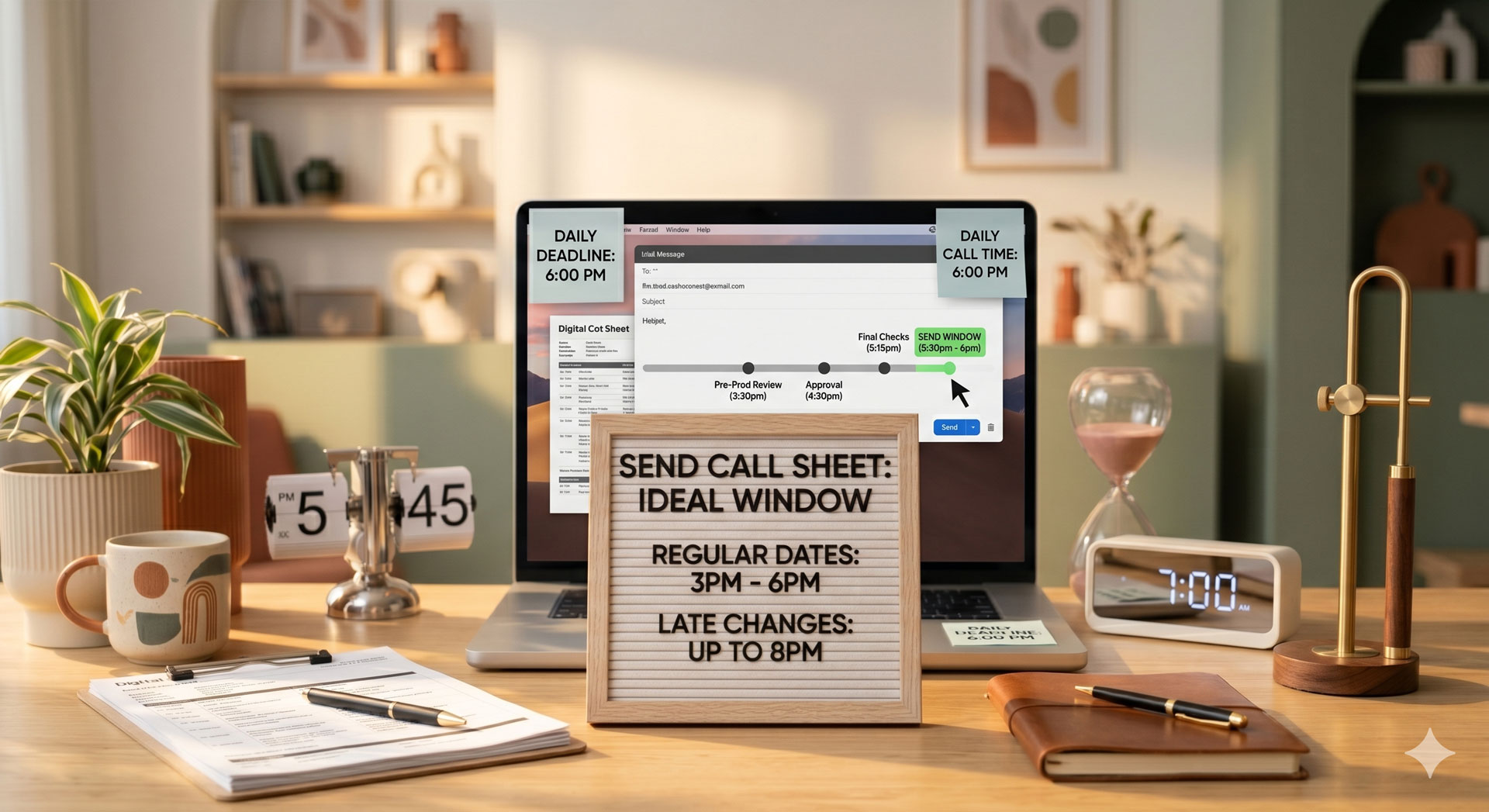
Send the call sheet the night before the shoot day, between 7 and 9 PM. That's the industry-standard window and the one every department head plans their evening around. Sent earlier than 6 PM and you'll have to chase mid-evening schedule changes with a re-send; sent after 10 PM and half your crew are already asleep.
Below is the full timing protocol, including what to do when something forces a late send and why the window matters more than most 1st ADs initially think.
The 7–9 PM rule
Every professional production treats 7–9 PM as the target window for call sheet distribution. The logic is straightforward:
- Before 7 PM — too early. Anything shifting between 5 PM wrap and the director's evening notes risks a revision, and crew who already read the sheet miss the update.
- 7–9 PM — the sweet spot. Crew read the sheet while winding down, have time to ask questions, and still get to bed at a reasonable hour.
- 9–10 PM — acceptable, but tight. Crew with early calls (hair/makeup at 5 AM) are already in bed by 10.
- After 10 PM — late. Send it anyway, but pair with a phone call.
The window assumes a standard call time of 6–8 AM. If you're running a night shoot, shift the window earlier — a call sheet sent at 3 PM for a 9 PM call is the night-shoot equivalent of the 8 PM send.
Why the window matters
The crew need time to read it, ask questions, and plan. A camera operator who realises at 9 PM that their call time is 5 AM has three hours to adjust sleep, childcare, and commute. The same operator realising the same thing at 11:30 PM is exhausted before the day starts.
More importantly, the 1st AD needs time to chase. A call sheet sent at 7 PM gives until 10 PM to see who hasn't opened it and text them. A sheet sent at 9:45 PM leaves no buffer.
Cast vs crew timing
On most productions, cast and crew get the same sheet at the same time. On some productions, cast receive a separate talent sheet with only their own info. Timing is identical: night-before, same window.
The exception is high-profile cast on studio productions, where talent sheets are sometimes delivered earlier in the afternoon via an agent or a dedicated coordinator. If your production has that structure, the 1st AD isn't handling cast distribution anyway — the talent coordinator is.
For the full breakdown of cast-specific call-sheet conventions, see our what is a call sheet post.
What to do when something runs late
Prep always runs over. Locations fall through at 6 PM. Directors finalise the shot list at 7. Weather shifts at 8. Here's the triage order when you can't hit the 9 PM window:
- 9 PM is achievable. Send. Normal workflow.
- 9 PM is not achievable, 10 PM is. Send at 10 PM with a clearly marked version number. No phone calls required unless the change is material (location or call time).
- 10 PM is not achievable. Call every department head personally. Brief them on tomorrow's call time, location, and any schedule changes. Send the sheet whenever it's ready. The call did the work the sheet normally does.
- It's midnight and you're still waiting on a location. Send the sheet with the location marked "TBD — final by 5 AM, follow driver instructions." Text every crew member directly with the final location as soon as it's confirmed.
The principle: if the document can't do the work in time, the phone does. Never let a late document replace human communication.
Handling revisions after the sheet is out
Locations fall through between the initial send and wrap-time. Weather shifts. A cast member gets sick. When the sheet needs to change after it's gone out:
- Material changes (location, call time, scene order) — re-send the full call sheet with a clearly marked "REVISED v2" banner at the top of page one. Include a version number and timestamp inside the document, not just in the filename.
- Minor changes (a note clarification, a phone number correction) — a text to affected crew is enough. Don't spam 40 people with a new PDF for a single-line update.
- Major changes after 10 PM — text or call affected crew directly. Email alone is not sufficient at that hour.
- Any change to safety-relevant info (hospital, stunt protocol, firearm handling) — re-send regardless of hour, and follow up with a direct message to the on-set medic and 1st AC.
Tools with delivery tracking show who's opened the current version. That matters more at 11 PM than at 7 PM — you want to confirm the third re-send actually reached the gaffer, not trust that it did.
Union and turnaround rules
Call-time timing is constrained by turnaround rules. Once the crew wraps today, they're entitled to a minimum rest period before tomorrow's call:
- SAG-AFTRA — 12-hour turnaround for actors as a baseline, with shorter turnarounds triggering a forced-call penalty.
- IATSE — typically 10-hour turnaround for crew in most regions, varying by local.
- DGA — 10-hour turnaround for directors, with 12 hours for ADs on certain productions.
- Non-union — no legal requirement, but 10 hours is the informal industry standard. Going under it burns crew goodwill fast.
These rules are the 1st AD's actual constraint on call-time timing, not the 7–9 PM send window. If today wraps at 10 PM and turnaround is 10 hours, tomorrow's earliest call is 8 AM regardless of what the producer wants. The call sheet reflects that math; the 1st AD doesn't negotiate it.
Always check the specific local and guild rules for your production. Turnaround requirements vary by region, project type, and contract.
How modern software handles timing
The send-time itself isn't hard to automate — a scheduled send at 7 PM is standard email functionality. The hard parts are:
- Knowing the sheet is actually ready by 7 PM (vs ready-with-placeholders).
- Tracking who's opened it so the 1st AD can chase stragglers before bed.
- Pushing revisions in one click when something changes at 9 PM.
These three are where dedicated software beats email-with-PDF-attachment. Production Slate's call sheet feature handles all three — auto-populated from schedule, sent with per-recipient acknowledge links, revised with a one-click push — so the timing protocol above becomes executable rather than aspirational.
Next step
For the underlying call-sheet workflow, see our step-by-step guide to making a call sheet and the complete call sheet checklist. For the landscape of tools that automate delivery and tracking, our best call sheet software comparison walks through what indie and mid-budget productions are choosing in 2026.
Written by Production Slate · Production Slate