Film Crew Positions Explained (Who Does What on a Film Set)
An org-chart walkthrough of every department on a film set — who reports to whom, and who actually calls the shots on a given day.
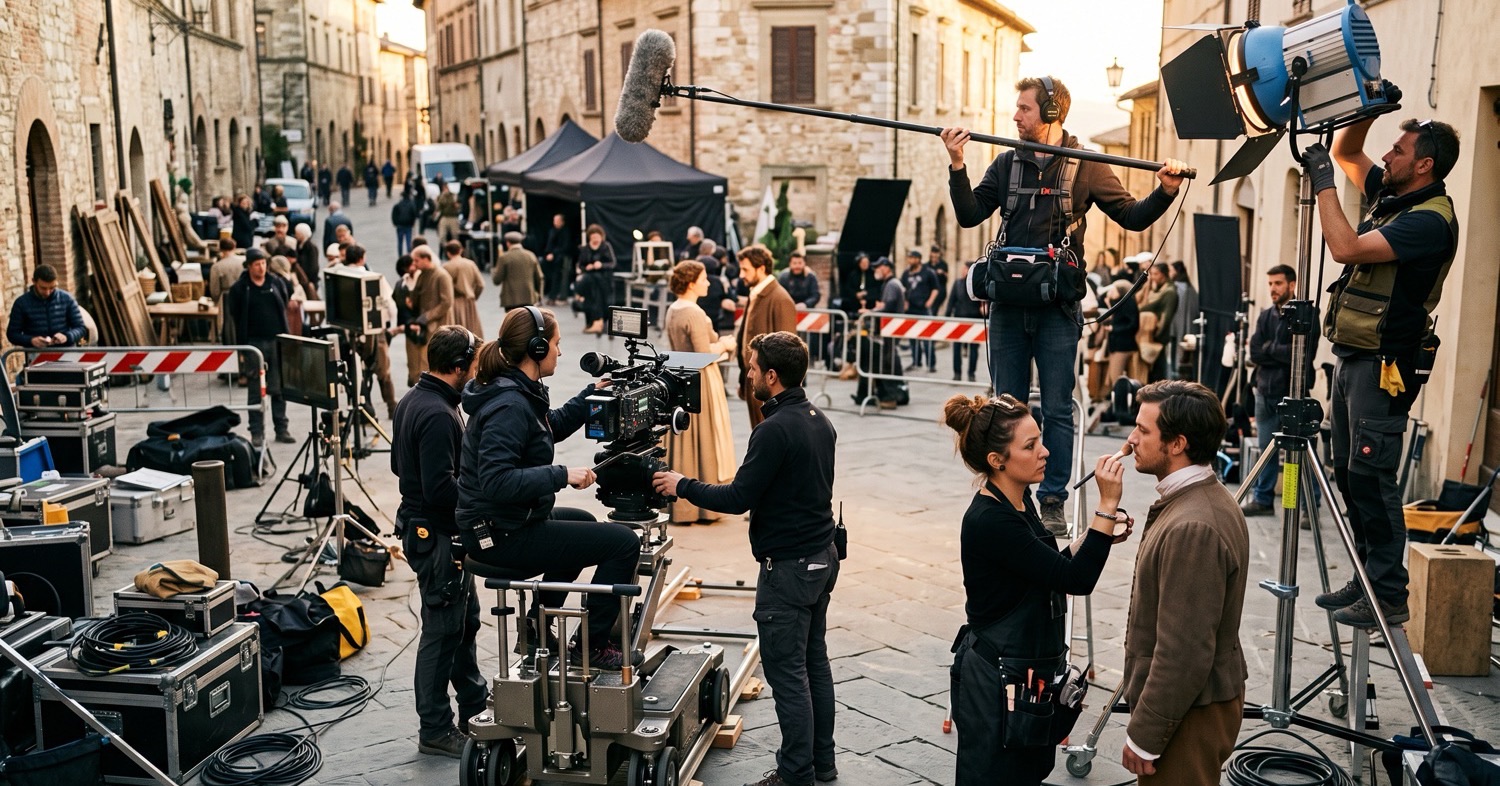
Film Crew Positions Explained (Who Does What on a Film Set)
A film set is organized into departments, and each department has a head who reports up to the 1st AD and producer. The producer and line producer own the budget and the deal; the 1st AD runs the day-to-day floor; department heads (DP, production designer, sound mixer, costume designer, gaffer, key grip) run their own crews and answer to the 1st AD for scheduling and to the producer for spend. Below each head sits a chain of specialists with narrower, well-defined jobs.
That's the whole system in one paragraph. The rest of this post is the org chart broken out by department, because the titles get confusing fast — especially for anyone crewing up their first shoot and wondering whether they need a key grip or a gaffer, a script supervisor or a script coordinator.
The chain of command, top to bottom
PRODUCER / EXECUTIVE PRODUCER   — owns the project, the money, the deals
    |
LINE PRODUCER / UPM             — owns the budget execution and logistics
    |
1ST ASSISTANT DIRECTOR          — owns the schedule and runs the set
    |
DEPARTMENT HEADS                — DP, Production Designer, Sound Mixer,
                                   Costume Designer, Gaffer, Key Grip,
                                   Location Manager, Script Supervisor
    |
DEPARTMENT CREWS                — 2nd AC, boom op, set dresser, best boy,
                                   grip, PA, etc.
This isn't a strict reporting line for every decision — a DP takes creative direction from the director, not the 1st AD — but for scheduling and set discipline, everyone answers to the 1st AD. For money, everyone answers to the line producer or UPM. We cover the producer-side roles in more depth in what does a line producer do and what does a UPM do, and the set-running role in what does a 1st AD do.
Production department
The production department is the administrative backbone: producer, line producer, UPM, production coordinator, production secretary, and PAs. They don't appear on camera and rarely appear in the shot-by-shot conversation, but nothing moves without them — permits, insurance, payroll, travel, the call sheet that goes out every night.
- Producer / Executive Producer — owns the project and the money.
- Line Producer — turns the script into a budget and keeps the shoot inside it.
- Unit Production Manager (UPM) — runs day-to-day logistics and the production office.
- Production Coordinator — the office hub: travel, paperwork, crew deals.
- Production Assistants (PAs) — set PAs (lockups, background, runs) and office PAs (paperwork, errands).
Assistant directing department
- 1st Assistant Director — builds the schedule (the stripboard), runs the floor, calls the roll of the day, and owns safety on set.
- 2nd Assistant Director — manages the cast, preps the next day's call sheet, and runs background/extras.
- 2nd 2nd AD — on larger shoots, handles background and crowd control so the 2nd AD can stay with principal cast.
Camera department
- Director of Photography (DP) / Cinematographer — owns the visual look of the film.
- Camera Operator — physically operates the camera (on smaller shoots, the DP often operates too).
- 1st Assistant Camera (1st AC / Focus Puller) — pulls focus, manages the lens and camera build.
- 2nd Assistant Camera (2nd AC / Clapper-Loader) — slates each take, manages camera reports, loads media.
- Digital Imaging Technician (DIT) — manages data, color, and the camera's digital signal path.
Sound department
- Production Sound Mixer — records and mixes location audio, owns the sound cart.
- Boom Operator — physically operates the boom mic, tracks actor blocking for mic placement.
- Utility Sound Tech — wires lavs, manages extra sound gear on larger crews.
Art department
- Production Designer — designs the overall visual world: sets, props, palette.
- Art Director — executes the production designer's vision on a practical, scheduled basis.
- Set Decorator — dresses the sets with furniture, props, and decor.
- Props Master — sources, tracks, and maintains every prop that talent handles.
Grip and electric
- Gaffer — the head electrician; designs and executes the lighting plan with the DP.
- Best Boy Electric — the gaffer's second, handles crew and equipment logistics.
- Key Grip — heads the grip crew, which supports the camera (rigging, dollies, flags, diffusion) and, jointly with electric, shapes and controls light.
- Best Boy Grip — the key grip's second.
- Dolly Grip — pushes and operates the camera dolly.
Wardrobe, hair, and makeup
- Costume Designer — designs the wardrobe for every character.
- Costume Supervisor / Set Costumer — manages continuity and on-set dressing changes.
- Key Hair / Key Makeup — designs the look; on larger shows, department heads supervise a team.
Script and continuity
- Script Supervisor — tracks continuity, dialogue accuracy, and scene coverage take by take; we go deep on this role in what does a script supervisor do.
Locations
- Location Manager — scouts, secures, and manages every location the production uses.
How big does a crew actually need to be?
A short film can run with a dozen people wearing multiple hats — one person as gaffer and key grip, one PA covering both set and office duties. A studio feature runs 150+ crew with several people under every title above. The org chart doesn't change; the headcount per box does. If you're staffing your first shoot and trying to figure out which of these roles you actually need on day one versus which can wait, how to crew up an indie film walks through the hiring order.
New crew and cast members also need to learn the unwritten rules fast — where to stand, when to talk, how to cross a set without walking through a shot. That's covered in film set etiquette for beginners.
Keep the org chart current, not just on paper
On paper, this chart is stable. On a real shoot, the crew list changes daily — a PA gets promoted mid-week, a rental house needs a fresh contact for the gaffer, a call sheet needs the right names next to the right titles the night before a shoot day. Production Slate's crew feature keeps your crew list, contact info, and department assignments in one place so the org chart above stays accurate on every call sheet you send, not just in your head.
Written by Production Slate · Production Slate