Film Set Etiquette for Beginners (Radio, Eyelines, and Not Getting Yelled At)
The unwritten rules of a film set — radio discipline, crossing the eyeline, video village behavior — that nobody explains but everyone expects you to know.
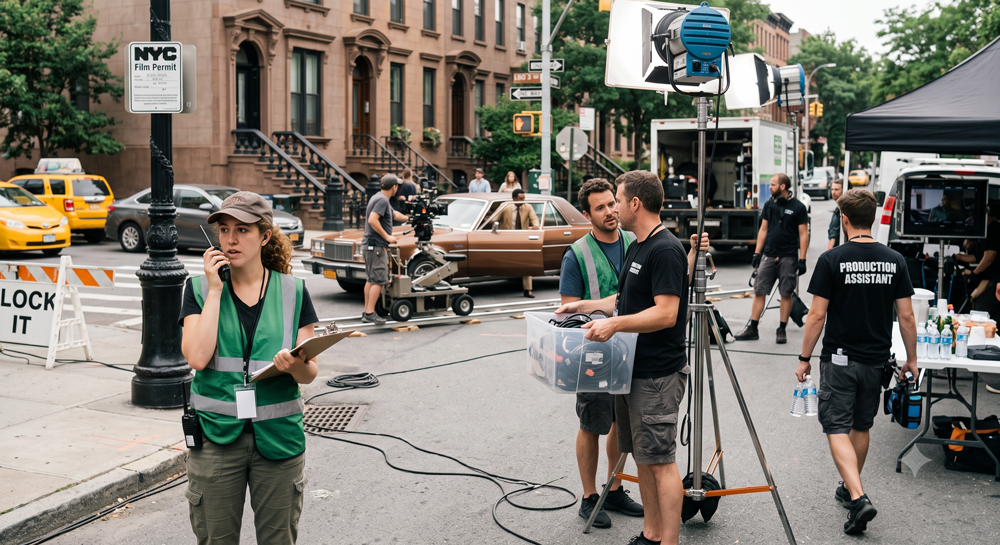
Film Set Etiquette for Beginners (Radio, Eyelines, and Not Getting Yelled At)
Film set etiquette comes down to three things: don't be seen or heard when the camera is rolling unless it's your job to be, don't waste anyone's time, and follow the chain of command instead of going around it. Almost every specific rule below is a version of one of those three. Nobody hands new crew a manual on day one — you're expected to pick it up by watching, and getting it wrong (even innocently) reads as inexperience fast.
This post exists because that gap between "nobody explains it" and "everyone expects you to know it" is exactly where new PAs and crew get burned. Here's what nobody tells you.
Radio etiquette
Most sets run on walkie channels, and radio discipline is one of the fastest tells of an experienced crew member versus a new one.
- Keep transmissions short. State who you're calling and who you are: "Basecamp, this is set." Wait for acknowledgment before continuing.
- Never talk over "rolling" or "cut." The 1st AD's calls take priority over every other transmission on the channel, always.
- Use the right channel. Larger productions split channels by department (1 = main/AD, 2 = background, 3 = camera/electric, etc.). Don't broadcast department chatter on the main channel.
- Say "copy" to confirm, not silence. Silence on a radio call reads as "did they hear me?" — always acknowledge.
- Step away to have a real conversation. If it's more than a two-line exchange, move off the radio and talk in person or on a side channel.
Crossing the eyeline (and the shot)
The "eyeline" is the actor's sightline during a take — the direction they're looking or performing toward. Crossing it while the camera is rolling ruins the take and is one of the fastest ways to become unpopular on set.
- If you need to cross set during a take, don't. Wait for "cut."
- If you absolutely must move during a take (an emergency, not a preference), stay low and move behind the camera's axis, never through the actor's eyeline or the frame.
- Learn where "the line" is before you're near it. Ask the 1st AD or a 2nd AD where you can and can't stand during a specific setup — this changes shot to shot.
- Stay off marks. Actor marks on the floor (tape, sandbags) are not for standing on, stepping over casually, or moving.
Video village rules
Video village is where the director, DP, script supervisor, and other key creatives watch the monitor feed. It's not a general hangout spot.
- Don't stand at village unless you have a reason to be there. If your department doesn't need eyes on the monitor, don't loiter.
- Silence, always. No side conversations, no phone sounds, no visible phone screens near the monitors during a take.
- Don't react out loud to what's on the monitor. Laughing, gasping, or commenting on a take in front of talent or the director — even a good reaction — is a distraction and can read as unprofessional.
General set behavior
- Follow the chain of command. If you have a question or a problem, take it to your department head, not directly to the director or producer, unless you're explicitly told to.
- Quiet on "rolling," full quiet on "picture's up." Learn the escalation: "settle" means quiet down, "rolling" means stop entirely.
- Don't touch gear that isn't yours, especially camera, sound, and props. A prop moved an inch can break continuity that the script supervisor then has to catch and fix.
- Learn set slang before you need it. Terms like "Abby Singer," "martini," and "checking the gate" get thrown around constantly — see our glossary of set slang if you're new and don't want to be the person asking what a "hot point" is mid-move.
- Be on time, every time. Call times aren't suggestions. Read the call sheet the night before, not the morning of.
- First team, second team — know the difference. Background and stand-ins move differently than principal cast; see first team, second team explained if those terms are new.
- Eat when craft services says to eat, not before. Meal breaks are scheduled around the shoot, not personal preference.
The rules that protect the schedule
A lot of etiquette exists purely to protect the 1st AD's schedule from small, avoidable delays. A crossed eyeline means a re-take. A PA on the wrong radio channel means a missed cue. A department head who skips the chain of command to lobby the director directly creates confusion that costs everyone time. None of these rules are arbitrary hazing — they're the accumulated fixes for problems that have cost real productions real minutes, over and over, for decades.
Where the day's rules actually live
Most of what's expected of you on a given day — call time, location, who's excluded from set, safety notes — is written on the call sheet, which is also where a lot of etiquette failures start: people who didn't read it. If you're building call sheets rather than just reading them, our guide on how to make a call sheet covers what belongs on it and why. And if you're the one sending it out, Production Slate's call sheet feature makes sure everyone on the crew list gets the current version — not last night's draft — before their call time.
Written by Production Slate · Production Slate