What Is Coverage in Film? (Masters, Angles, and the 180-Degree Line)
Coverage is the set of shots that lets an editor actually cut a scene together. Here's how masters and angles work, why crossing the line breaks it, and how script supervisors keep it all straight.
What Is Coverage in Film? (Masters, Angles, and the 180-Degree Line)
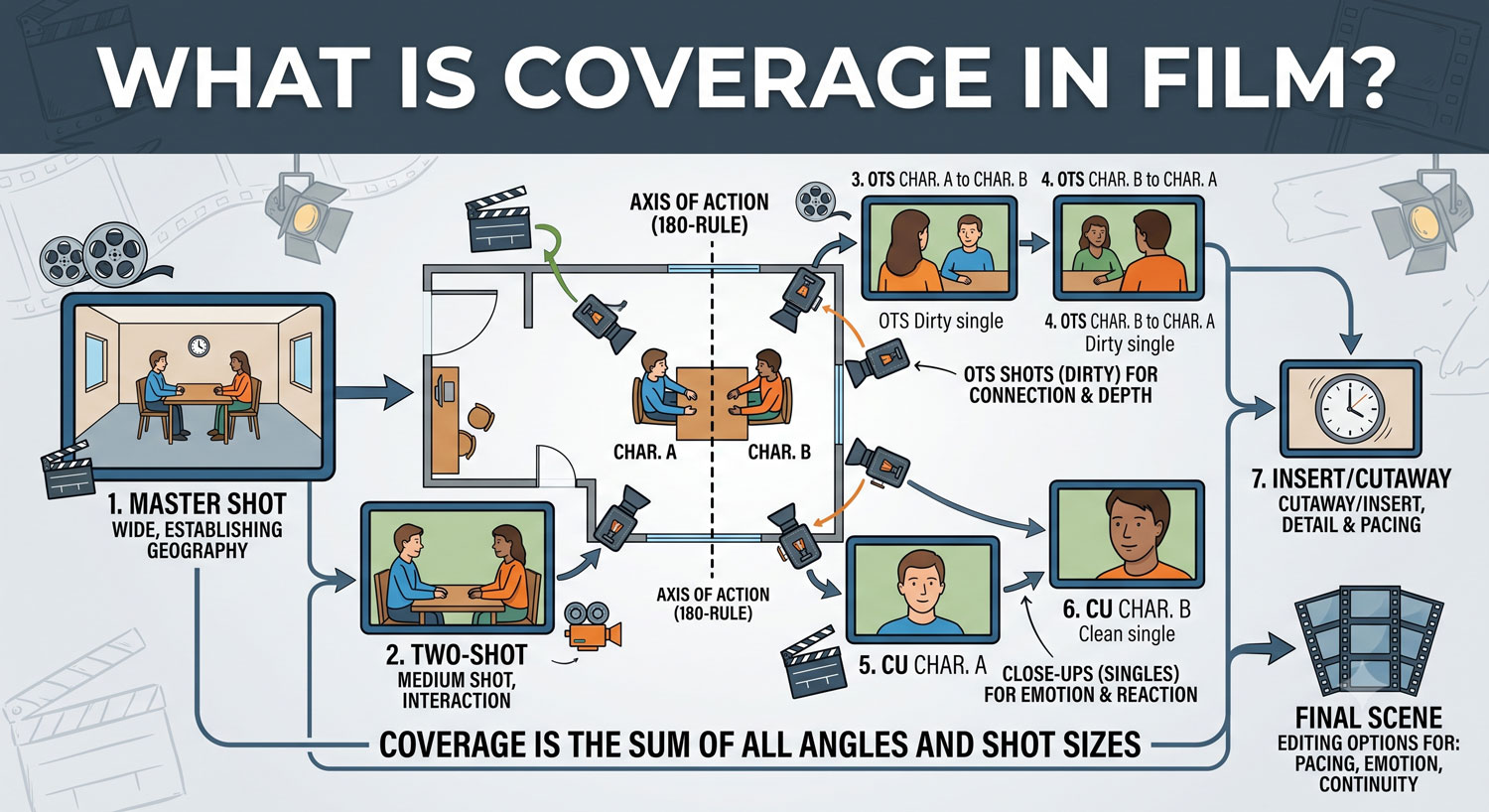
Coverage is the collection of shots — a master plus supporting angles — that gives an editor enough material to actually cut a scene together. A single shot of a two-person conversation isn't editable; there's nothing to cut to. Coverage exists to solve that problem, and how much of it you shoot is one of the most consequential planning decisions on any shoot day.
The 50-word definition
Coverage is the set of camera angles shot for a scene — typically a wide master plus tighter shots on each character or action beat — that gives an editor enough footage to cut the scene together with pacing control. More coverage means more editing flexibility; less coverage locks the edit closer to what was shot.
The master shot
Most scenes start with a master: a single, continuous wide shot that captures the whole scene from start to finish, with all the actors and blocking visible. The master is the safety net — if every other angle falls through, the scene still exists as one usable take. It's also the timing reference every other angle gets cut against.
Coverage angles
On top of the master, a scene typically gets tighter shots that let the editor vary pace and perspective: over-the-shoulder shots favoring each speaking character, singles (a close-up on just one person), two-shots, and inserts on relevant objects. How many of these a scene needs depends on its length, emotional weight, and how much the editor will need to compress or restructure it later. A short, functional scene might get away with a master and two singles. A pivotal dramatic scene often gets far more.
If you're deciding how to translate a coverage plan into an actual ordered list of setups, that's the shot list — see what is a shot list and our step-by-step build guide for the process. The shorthand used to describe these angles (OTS, MCU, INSERT, and so on) is covered in our abbreviations reference.
Why coverage matters more than it looks like it should
Coverage is an insurance policy against decisions made after the shoot. A performance that reads as too intense in a master might read fine in a wider two-shot the editor pulls in instead. A line reading that doesn't land in the wide might be saved by cutting to a reaction shot at the right beat. None of that flexibility exists if the only thing in the can is the master.
The tradeoff is time — every additional angle is a full re-light and re-set on many productions, or at minimum, another few minutes of setup and takes. This is exactly why coverage decisions belong in prep, not on the day: deciding a scene needs five angles when you've budgeted time for three is a schedule problem discovered too late to fix cheaply.
Crossing the line (the 180-degree rule)
The 180-degree rule is the convention that keeps coverage cuttable: once you establish an imaginary line running through the axis of action — between two people talking, or along the direction of movement in a chase — the camera should stay on one side of that line for the whole scene. Shoot from both sides and the two angles won't cut together cleanly; characters will appear to swap screen sides or face the wrong direction relative to each other, which reads as a jarring, disorienting error even to audiences who couldn't name the rule.
There are legitimate reasons to cross the line deliberately — a character walking through a room can justify a new line, and some directors cross it intentionally for a specific disorienting effect — but doing it by accident is one of the most common on-set mistakes that only becomes visible in the edit, by which point a reshoot is often the only fix.
How script supervisors track it
On a professional set, the script supervisor is the person responsible for confirming that coverage actually happened the way it was planned — that every angle on the shot list got shot, that eyelines and continuity match across setups, and that nobody crossed the line without a deliberate reason. That tracking happens take by take, logged against the scene as the day progresses, and it's what makes it possible to catch a missing angle before the company wraps the scene rather than in the edit bay months later.
This is a distinct skill from building the coverage plan in prep — it's the real-time discipline of confirming the plan was executed. If you want the mechanics of how that tracking works on the day, our companion posts on script lining and circle takes cover the specific tools script supervisors use to log it.
Coverage and the schedule
More coverage on a scene means more shots, which means more setups, which means more time — a relationship that has to feed into your stripboard and your day out of days during scheduling, not just your shot list during prep. A scene that's underestimated for coverage in the schedule is exactly the scenario that forces the kind of shot-cutting decisions we cover in how to make a shot list — deciding, mid-day, which angles you can live without.
Plan it, don't discover it
Coverage decisions made in prep are cheap. Coverage gaps discovered in the edit are expensive, sometimes unfixable without a reshoot. Production Slate's script module includes a script supervision log built for exactly this — tracking takes, coverage, and continuity notes scene by scene as the day happens, so what got shot and what's still missing is never a guess by the time the company wraps.
Written by Production Slate · Production Slate