Shot List Abbreviations Cheat Sheet (WS, MS, CU, OTS, POV, and More)
Every common shot list abbreviation decoded — shot sizes, angles, and camera movement terms — in one reference you can screenshot and keep on your phone.
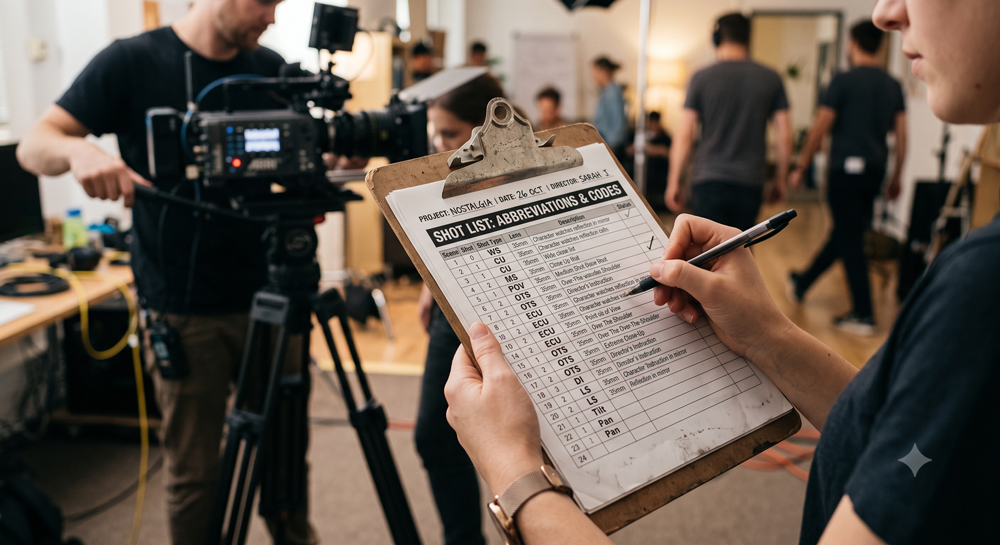
Shot List Abbreviations Cheat Sheet (WS, MS, CU, OTS, POV, and More)
Shot lists run on shorthand because there isn't time on set to write "medium close-up" seven times a page. Below is every abbreviation you'll actually run into on a working shot list, grouped by shot size, specialty angle, and camera movement, with the version most US sets use. Some productions vary a letter or two — note that below where it matters.
Shot sizes (widest to tightest)
| Abbreviation | Full name | What it shows |
|---|---|---|
| EWS / ELS | Extreme wide shot / extreme long shot | Subject small in frame, establishes scale and place |
| WS / LS | Wide shot / long shot | Full body, full location context |
| FS | Full shot | Full body, head to toe, less environment than a WS |
| MS | Medium shot | Roughly waist up |
| MCU | Medium close-up | Roughly chest up |
| CU | Close-up | Face fills most of the frame |
| ECU / XCU | Extreme close-up | A detail — eyes, hands, an object |
There's no hard-and-fast rule where an MS ends and an MCU begins — DPs and directors calibrate by eye on the day. What matters is that the terms are used consistently within a single shot list so the crew isn't guessing what "medium" means scene to scene.
Specialty angles and configurations
| Abbreviation | Full name | What it means |
|---|---|---|
| OTS | Over-the-shoulder | Camera looks past one character's shoulder at another |
| POV | Point of view | Frame represents what a character sees |
| 2SHOT | Two shot | Two subjects framed together |
| 3SHOT | Three shot | Three subjects framed together |
| INSERT | Insert shot | A tight, isolated detail — a note, a phone screen, a clock |
| CUTAWAY | Cutaway | A shot of something outside the immediate action, used to bridge an edit |
| REVEAL | Reveal shot | Camera or subject movement that uncovers new information |
| MASTER | Master shot | A wide, continuous shot covering the whole scene in one take |
OTS shots are often written with the subject who's favored in frame noted alongside — for example OTS-T means an over-the-shoulder favoring "Tom," even though Sarah's shoulder is in the foreground. If your list has two characters trading OTS coverage, this notation keeps them from getting swapped in the edit. Like stripboard colors, these abbreviations only work when everyone reads them the same way — consistency beats cleverness.
Camera movement terms
| Term | What the camera does |
|---|---|
| PAN | Rotates horizontally from a fixed position |
| TILT | Rotates vertically from a fixed position |
| DOLLY IN/OUT | Moves the whole camera body toward or away from the subject |
| TRUCK L/R | Moves the whole camera body sideways, parallel to the subject |
| CRANE / BOOM | Moves the camera up or down, often on an arm |
| ZOOM IN/OUT | Changes focal length without moving the camera body |
| HANDHELD | Operator holds the camera without a stabilizing rig |
| STEADICAM | Operator wears a stabilizing rig for smooth handheld-style movement |
| RACK FOCUS | Shifts focus from one subject or plane to another mid-shot |
| WHIP PAN | A very fast pan, often used as a transition |
The one distinction worth memorizing: a dolly move physically relocates the camera; a zoom changes the lens's focal length while the camera stays put. They can look superficially similar in a still frame but read completely differently in motion, and mixing them up in a shot list description will send the wrong grip equipment to set.
A note on consistency, not universality
These abbreviations are the common US set convention, but they're not a legally binding standard — some DPs use XCU instead of ECU, some crews write "M/S" with a slash, and international productions sometimes use different terms entirely. The abbreviation itself matters less than every department reading the same shot list agreeing on what it means. If you're working with a crew that has its own house shorthand, put a one-line legend at the top of the shot list rather than assuming everyone shares your defaults. It's the same discipline behind stripboard color coding — a shorthand system only works if everyone on the crew reads it the same way.
Camera package and who calls the movement
Which movement terms actually make it onto your shot list often comes down to what's in the truck that day — a dolly move assumes a dolly and track got ordered, a steadicam shot assumes an operator was booked. If you're planning gear ahead of a shoot day, camera package basics covers what's typically included and what gets added for specific movement needs. On the day itself, it's usually the camera operator or DP calling movement, while the camera log records what was actually shot, take by take.
Where this fits on the page
These codes are most useful in the shot type column of a working list — see our shot list template for a full copy-paste layout with that column already built in. If you're still deciding what coverage a scene actually needs before you start assigning shot types, what is coverage in film covers the masters-and-angles logic underneath these terms. And if you're building your first list from scratch, our step-by-step guide walks through the whole process, abbreviations included.
Keep it on hand
Screenshot the tables above or print them on the back of a call sheet — most 1st ADs and script supervisors keep a version of this cheat sheet until the terms are second nature. Inside Production Slate's shot list feature, shot type is a dropdown built from this exact list, so new crew members don't have to memorize the shorthand before they can start building a plan for the day.
Written by Production Slate · Production Slate