Continuity Mistakes and How to Avoid Them
Eyelines, wardrobe, props, and screen direction — the continuity errors that show up most often, and the habits that catch them before the edit.
Continuity Mistakes and How to Avoid Them
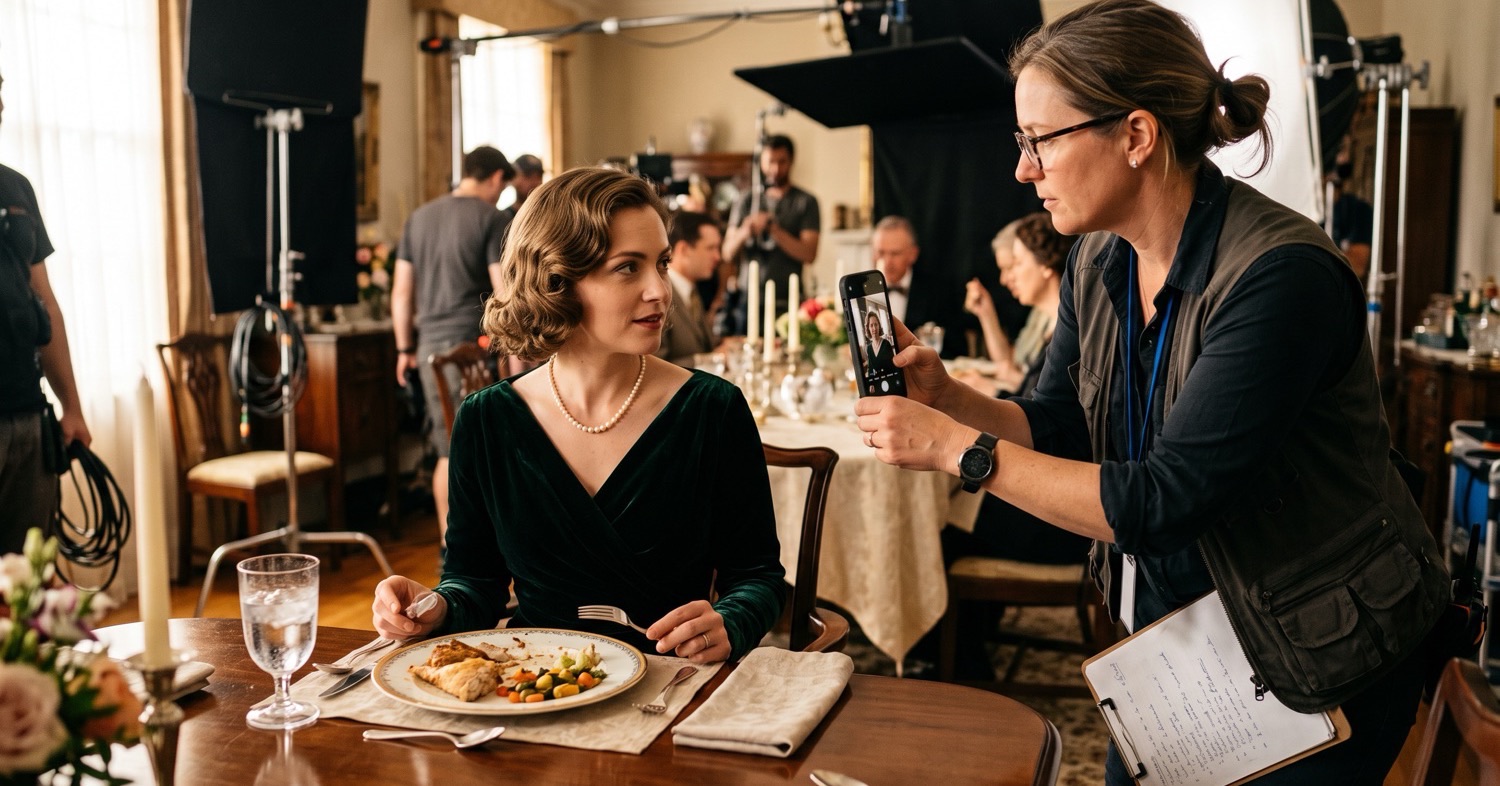
Continuity mistakes happen when something visible or audible in a scene changes between shots that are supposed to be seamless — a prop moves hands, a costume detail resets, an actor's eyeline lands on the wrong side of the frame. Most of them are avoidable with a specific habit: write it down and check it before every take, rather than trusting memory across a lunch break, an overnight, or a company move back to a location three weeks later.
This post covers the patterns that come up most often and what actually catches them, not the theory — in the same spirit as our rundown of call sheet mistakes, most of these are process failures, not talent failures. For the role that owns this work day to day, see what does a script supervisor do; for the paperwork that maps coverage against continuity notes, see what is script lining.
Eyelines
An eyeline mismatch happens when a character appears to be looking at the wrong thing or the wrong person once two shots are cut together — most often because the actor they were talking to wasn't actually there for a later shot (shooting singles without a stand-in), or because the camera crossed the 180-degree line between setups without anyone flagging it.
What catches it: always use an eyeline mark or a stand-in at the correct height and position when the scene partner isn't physically on set for a shot. If the camera has to cross the line for a legitimate creative reason, decide that on purpose during blocking, not by accident in the edit.
Wardrobe continuity
Buttons done up or open, a jacket on or off, sleeves rolled — wardrobe continuity breaks constantly because actors adjust their own clothes between takes without thinking about it, and because a scene shot out of order (interiors on day 2, the exterior that leads into it on day 9) has no visual anchor connecting the two setups except a photo taken on day 2.
What catches it: a continuity photo of the actor from multiple angles at the start of every new setup, checked against before the next one. This is tedious and it's also the single highest-value habit a production can adopt, because wardrobe breaks are the most visible kind of continuity error to an audience.
Props
Which hand holds the drink, how full the glass is, whether a cigarette has burned down, where a phone sits on a table — prop continuity fails when a prop resets between takes (a full drink poured back after each take instead of tracked as it depletes) or when a scene is picked up later in the day and nobody logged where things were left.
What catches it: the same photo-and-note habit as wardrobe, owned jointly by the script supervisor and the props department, plus a rule that props aren't reset without a note of what state they were in when the camera last rolled.
Screen direction
Screen direction breaks when a character or vehicle appears to reverse the direction they were traveling once two shots are cut together — most commonly in chase or travel sequences shot across multiple setups and sometimes multiple locations standing in for one continuous journey.
What catches it: deciding and writing down a direction of travel before blocking the first shot (left-to-right, or right-to-left) and holding every subsequent setup to it unless the camera deliberately crosses the line with a clean motivated move — a beat that becomes the connective shot between the two directions rather than an accidental jump.
Time-of-day and light
Shooting a scene that's supposed to be one continuous afternoon across an actual production day means natural light changes underneath the actors — shadows shift, an overcast sky the crew waited out returns, golden hour arrives before the last shot is in the can.
What catches it: shooting available-light-critical shots in a deliberate order (widest or most light-sensitive first), and flagging to the DP early when a scene is running long enough that the light won't match by the time coverage finishes. This is a scheduling problem as much as a continuity one — see split days and night shoots explained and cover sets and weather contingency for how productions plan around exactly this risk.
Dialogue and action drift
Actors paraphrase. A line delivered word-for-word in the master gets slightly reworded by take four of the close-up, and if nobody flags it, editorial discovers mid-cut that the two shots don't actually match line for line.
What catches it: the script supervisor following along with the script during every take, not just watching performance, and speaking up immediately (this is one of the few moments a non-director is expected to interrupt a take) when a line drops or changes in a way that will matter for the cut.
The habit underneath all of these
Every category above has the same fix: a specific, written note taken at the moment of the take, not a mental note taken to be recalled later. Continuity errors aren't usually caused by carelessness — they're caused by relying on memory across a gap (a lunch break, an overnight, a reshoot three months later) that memory isn't built to survive. The script supervisor's daily report exists specifically to hold that information somewhere durable, and circle takes get flagged partly on the strength of which take had the cleanest continuity, not just the best performance.
Build the habit into your workflow, not around it
Continuity notes are only useful if they're attached to the actual scene and shot they describe, and still findable when an editor opens that scene weeks later. Production Slate's script supervision log keeps continuity notes, lining, and camera log entries tied to the same scene and shot records your breakdown already uses, so nothing lives in a separate notebook that gets left in a production office.
Written by Production Slate · Production Slate