What Is an Eighth of a Page? (Script Timing, Explained)
Eighths are how the film industry measures scene length for scheduling — not literal fractions of a printed page, but a rounding convention every 1st AD lives by. Here's how to count them.
What Is an Eighth of a Page? (Script Timing, Explained)
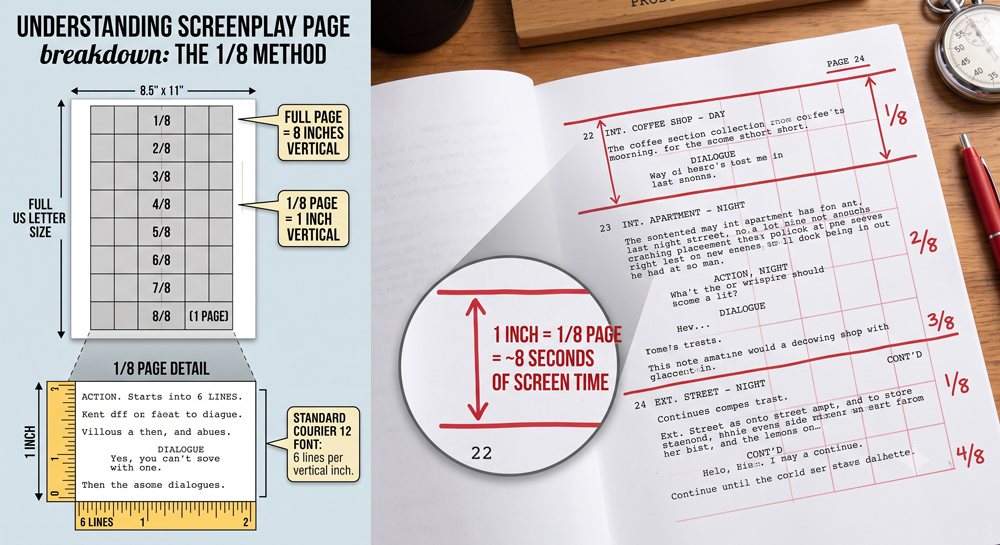
An eighth of a page — usually written "1/8" — is the standard unit the film industry uses to measure how long a scene is for scheduling purposes. Every screenplay page is treated as eight eighths, and every scene is rounded up to the nearest eighth, even if it's only two lines of dialogue. Add up the eighths across a day's scenes and you get a number your 1st AD uses to judge whether the day is shootable.
It sounds like a strange way to measure length in 2026, and it kind of is — the math traces back to formatting quirks of the physical typed page. But the convention stuck around because it works better than the alternatives, and it's still exactly how schedules, one-liners, and day-out-of-days reports get built today.
The 50-word definition
An eighth of a page (1/8) is the film industry's unit for scene length: each script page equals 8/8, and any partial scene rounds UP to the next eighth (a two-line scene is still 1/8, never less). Eighths are totaled per scene, per day, and per schedule to estimate shoot time and pace.
Where the "eighths" convention comes from
Standard screenplay format runs roughly one minute of screen time per page, which is why a feature script lands somewhere around 90-120 pages. Long before digital tools existed, script supervisors and ADs needed a finer-grained unit than "whole pages" to schedule a day, because most scenes don't end conveniently at the bottom of a page. Dividing the page into eighths — a clean fraction that's easy to eyeball on a printed page — gave them a common currency for partial scenes.
In modern practice, nobody's measuring physical eighths of an inch on the page with a ruler. It's a page-count convention: you look at how much of the page a scene occupies and round to the nearest 1/8, always rounding up on any partial eighth. A scene that fills the whole page is 8/8. Half a page is 4/8. A scene that's barely two lines long still gets scored as a minimum of 1/8 — you never round down to zero, because even a tiny scene requires its own setup, blocking, and take.
This is the same counting step covered in how to break down a script, where page-count tagging happens alongside cast, prop, and location tags during breakdown. If you haven't seen how eighths fit into the bigger breakdown process, what is a script breakdown is the place to start.
Why eighths instead of pages or word counts
Plain page counts and word counts both sound more precise than eighths, but they're worse predictors of how long a scene takes to shoot. Here's why:
- Page density varies wildly. A page of rapid-fire dialogue with no action lines reads faster on screen and shoots faster on set than a page that's mostly action description and blocking. Two "one-page" scenes can take wildly different amounts of setup time.
- Eighths correlate to screen time, not word count. Because standard format holds to roughly a minute per page, eighths give you a rough time estimate (an 8/8 scene is about a minute of screen time) that a word count simply doesn't.
- Eighths correlate to setup complexity better than raw length. A short scene with a big stunt or a company move eats more of the day than its 2/8 page count suggests — but eighths still give the AD department a consistent baseline to adjust from, rather than starting from nothing.
- It's the shared language of every scheduling document. One-liners, day-out-of-days reports, and stripboards all report scene length in eighths, so switching to a different unit would mean re-deriving every other tool from scratch. See what is a one-liner schedule and what is day out of days for how eighths show up downstream.
How eighths get totaled
Eighths roll up at three levels:
- Per scene — each scene gets a page-eighths value during breakdown (e.g., Scene 14 = 3/8).
- Per scene day — if a scene is scheduled across multiple shoot days (common on complex scenes), its eighths get split across those days.
- Per shoot day — every scene scheduled on a given day has its eighths added together, giving you the day's total page count. This is the number your 1st AD compares against a target pace to decide whether the day is realistic.
Worked example
Say you're breaking down a 5-page scene — a big dinner-table argument that runs the full length of pages 12 through 16.
Page 12: full page                     = 8/8
Page 13: full page                     = 8/8
Page 14: full page                     = 8/8
Page 15: full page                     = 8/8
Page 16: scene ends 3 lines down       = 1/8 (rounded up)
---------------------------------------------------
Scene total                            = 33/8 pages (4 3/8 pages)
Now say that scene is one of six scheduled for a single shoot day, alongside five shorter scenes:
Scene 14 (dinner argument)   = 33/8
Scene 2  (hallway walk-talk) = 4/8
Scene 9  (phone call insert) = 1/8
Scene 22 (car arrival)       = 2/8
Scene 23 (doorstep)          = 5/8
Scene 31 (exterior establishing) = 1/8
---------------------------------------------------
Day total                    = 46/8 pages (5 6/8 pages)
That "5 6/8 pages" figure is what goes on the call sheet and the one-liner, and it's the number your 1st AD weighs against how much time, cast, and setup complexity the day realistically allows.
What counts as a reasonable day
There's no single universal pages-per-day number that applies across every production — a dialogue-heavy two-hander on one location schedules very differently from an action sequence with a dozen setups, and budget, cast availability, and company moves all move the target. Your 1st AD sets the day's target based on the day's actual complexity, not a rule of thumb pulled from a textbook. If you want the fuller discussion of typical pace ranges and how they shift by genre and budget tier, see how many script pages per day.
Where eighths really pay off is once you're building the schedule itself — laying scenes onto a stripboard or working through a shooting schedule template, the running eighths total per day is the constraint you're constantly checking against.
How Production Slate handles this
Hand-counting eighths off a printed script is tedious and error-prone, especially once you're re-balancing a schedule for the third time. Production Slate calculates page-eighths automatically for every scene when you import a script, then rolls those numbers up live as you drag scenes onto shoot days — so your daily and cumulative eighths totals update instantly instead of getting recalculated by hand every time the board changes.
Build your schedule around real eighths totals
If you're scheduling a shoot, Production Slate's schedule tools track page eighths automatically from your imported script, roll them up per day, and flag days that are overloaded before you're on set finding out the hard way. Give it a look if you're tired of doing this math in a spreadsheet.
Written by Production Slate · Production Slate