Digital vs Paper Call Sheets: Which Is Better in 2026?
A practical comparison — when a digital call sheet saves your day, and when you still want paper in the glovebox.
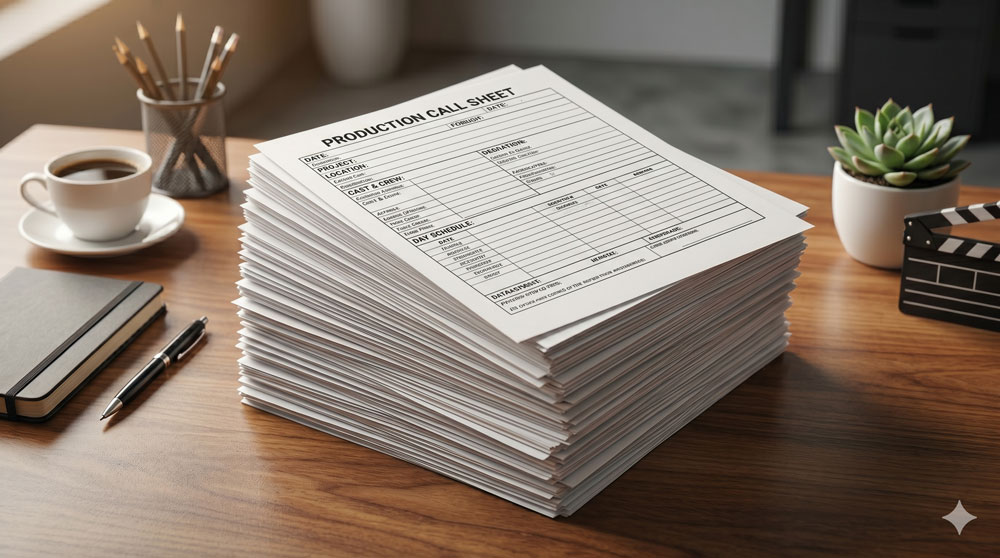
Digital vs Paper Call Sheets: Which Is Better in 2026?
Digital call sheets win on 95% of shoots. They update in real time, track who's confirmed, render on every phone, and survive the "I thought you sent me the revised one" conversation at 7 AM. Paper still has a role — two or three specific situations where it earns the ink and the stapler — but if you're building a default workflow from scratch in 2026, it's digital first, paper as a fallback.
Below is the short version of where each one wins, and the hybrid workflow most professional crews have settled on.
The quick verdict
- Use digital as your default. Auto-populated, trackable, updatable, readable on phones.
- Print paper copies for three specific situations: remote shoots with spotty signal, any vehicle going to a second location, and the 1st AD's own reference copy.
- Stop emailing PDFs as attachments. PDF as a format is fine. Email as the transport layer has no delivery tracking, no revision control, and no acknowledgement. Move to a tool that does all three.
What digital call sheets do better
Auto-populate from the schedule. A digital tool pulls crew, cast, location, weather, sunrise/sunset, and hospital from the production's source data. No retyping, no copy-paste errors from yesterday's document. Our step-by-step guide walks through the workflow; most of it disappears when the software handles population automatically.
Track delivery per recipient. The 1st AD knows at 10 PM that the gaffer hasn't opened the call sheet yet. They send a text. Problem solved before it's a problem. Paper gives you no signal — you hand 40 copies to a PA at wrap and hope they make it home.
Revise without chaos. Location falls through at 6 PM. A digital tool lets you push the revision to everyone in one click, with a clear "REVISED v2" banner. Crew see the updated sheet on their phone. Paper means reprinting, re-distributing, and fielding texts from three crew members who have the old version.
Render correctly on phones. Most crew read the call sheet in bed at 10 PM on their phone. A well-built digital tool renders cleanly at any screen size. A PDF email attachment rendered by whichever mail client the crew uses is a gamble.
Acknowledge and accept. Digital tools let recipients click to confirm they've read the call sheet. That confirmation becomes a legal record — useful in grievance disputes when crew claim they weren't notified of a hazard.
Where paper still wins
Three situations, in order of how often they come up.
Remote shoots with no signal. Anything more than 30 minutes from a town is a candidate for printed sheets. Not because digital fails, but because the dead phone in someone's pocket at lunch doesn't. Print the sheet on the last day you have signal; fold it into the back of the clipboard; keep moving.
Second-unit trucks and caravan splits. When the shoot moves mid-day to a second location and the 2nd unit splits off, paper call sheets in each truck guarantee the driver and the gaffer are looking at the same document. Signal in the back of a van is unreliable.
The 1st AD's own copy. Most 1st ADs still carry one printed copy, annotated in marker over the course of the day. It's faster than phone-based note-taking, the battery doesn't die, and it can be Sharpied to a production board at lunch for everyone to reference.
Beyond those three, paper is nostalgia. Keep the clipboard; switch the document.
The hybrid workflow most crews actually run
Here's what a professional 1st AD's daily cadence looks like in 2026:
- Night before, 7–9 PM. Build or auto-populate the call sheet in a digital tool. Send via the tool's own delivery (email with per-recipient acknowledge links), not as a blind PDF attachment.
- Night before, 9–10 PM. Check the delivery board. Crew who haven't opened the sheet get a text.
- Morning of, 4–5 AM. Production coordinator prints 10–15 paper copies: one for the 1st AD, one for the DP, one for the gaffer, one for each department head who prefers paper, one for each vehicle going off-site, and three spares.
- On set, all day. Crew reference the digital version on their phones. The AD team works from the paper copies on their clipboards.
- Any revision during prep or shoot day. Push through the digital tool. Reprint the paper copies for the AD team if the change is material; ignore if minor.
This hybrid is faster than either extreme. Digital carries the distribution burden; paper covers the 10% of moments where a screen is the wrong tool.
The liability angle (why tracking matters)
Call sheets carry safety information — hospital, medic, firearm protocols, weather hold plans, stunts. If a crew member is injured and later disputes whether they were given safety information, "we emailed the call sheet" is a weaker record than "the system logs that this person opened the sheet at 10:47 PM and clicked acknowledge at 11:02 PM."
On union productions this matters. On non-union productions it matters more, because the grievance pathway runs directly through civil court rather than through a union arbitration process that industry understands.
Delivery tracking isn't just a nice-to-have for the 1st AD's peace of mind. It's a liability log.
How to transition a paper-first crew to digital
If your department heads are paper-native, don't start the fight by banning paper. Do this instead:
- Keep printing for the first two weeks. Send digital and print paper. Let crew see the digital version land on their phone and compare it against the paper.
- Stop volunteering paper after two weeks. If someone asks for a printed copy, give them one. Don't pre-print a stack.
- Point out the obvious win. When the location changes at 5 PM and the revised call sheet lands on their phone in 30 seconds, crew notice.
- Keep paper for the three situations above. This isn't an ideological fight. Keep the tool that works where it works.
Most paper-first crews are digital-first within a month.
Next step
Pick a digital tool, run the hybrid workflow above for your next shoot, and keep a clipboard for the 1st AD. For the call sheet layout itself, grab our free template or use Production Slate's auto-populated call sheets with per-recipient delivery tracking baked in. For the software landscape, we compared the eight tools indie productions are actually using in our best call sheet software post.
Written by Production Slate · Production Slate