What Is Petty Cash in Film Production? (Floats, Receipts, Reconciliation)
Petty cash keeps a shoot moving when a purchase can't wait for a PO — but only if every dollar comes back with a receipt attached.
What Is Petty Cash in Film Production? (Floats, Receipts, Reconciliation)
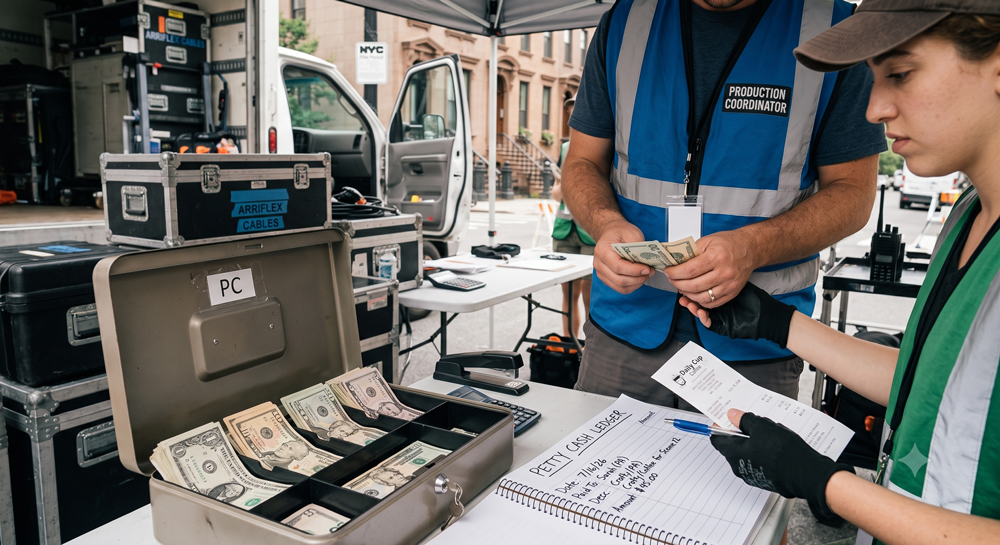
Petty cash is a small, physical cash fund kept on hand during production to cover purchases too small or too urgent to route through a formal purchase order — a run to the hardware store for a prop fix, parking for a location van, batteries nobody budgeted for. It exists because a film set generates dozens of small, unpredictable expenses every day, and routing every one of them through an approval chain would grind the day to a halt.
The system only works if it's tight: every dollar handed out gets tracked to a specific person, and every dollar spent comes back with a receipt. Loose petty cash handling is one of the fastest ways an indie production loses track of real spend, because small cash draws are exactly the kind of cost that doesn't show up anywhere else until someone goes looking.
The 50-word definition
Petty cash is a cash fund kept on set to cover small, urgent purchases that can't wait for a formal purchase order — parking, minor supplies, small prop or wardrobe fixes. It's distributed in floats to department heads or PAs, tracked against receipts, and reconciled regularly so every dollar spent is accounted for.
How the float system works
Petty cash is distributed as floats — a fixed cash amount handed to a specific person (usually a department head, key PA, or the production coordinator) who's responsible for that money until it's reconciled. A typical structure:
Petty cash log — [Department]
Custodian:        _______________
Float issued:     $______  on  [date]
Float balance:    $______  (float amount minus receipts turned in)

Date  | Item                     | Amount | Receipt attached?
------|--------------------------|--------|-------------------
      |                          |        | Y / N
------|--------------------------|--------|-------------------
      |                          |        | Y / N
When the float runs low, the custodian turns in receipts totaling the amount spent, and production accounting replenishes the float back to its original amount. The float itself never grows — only the receipts prove where the money went.
Why receipts aren't optional
Every petty cash purchase needs a receipt, no exceptions, for two reasons that matter independently:
It's the only proof the money was spent on production business. Without a receipt, a cash withdrawal is indistinguishable from money that just disappeared — and on an indie budget with thin margins, that ambiguity is expensive even at small dollar amounts.
It's what feeds the actual cost tracking. Petty cash purchases are real production spend and belong in the same hot cost report as every invoiced expense. A production that lets petty cash purchases go untracked is quietly running a chunk of its actual spend outside its own budget visibility — often the exact chunk that would reveal a department is overspending on small stuff faster than expected.
When a receipt genuinely can't be obtained — a rare cash tip, a vendor who doesn't issue one — the custodian should write a note explaining the purchase, the amount, and the date, and get a supervisor's signature on it. That's a fallback for exceptions, not a habit.
Reconciliation: closing the loop
Reconciliation is the process of confirming that float amount minus receipts equals cash on hand, done on a fixed schedule — weekly is typical on an indie shoot, more often on a larger production with bigger floats. The math is simple:
Float issued          $500
– Receipts turned in   $340
= Cash remaining       $160  <- should match physical cash on hand
If the numbers don't match, that's flagged and resolved immediately — not carried forward to the next reconciliation, where it becomes harder to trace back to a specific purchase or day.
At wrap, every float gets a final reconciliation and any unspent cash is returned. Unreturned or unreconciled petty cash at wrap is a common source of budget disputes during the final cost report process, precisely because it's the hardest category of spend to trace back after the fact.
Petty cash and the wider budget
Petty cash is a below-the-line operational cost, not a separate budget category — it should map back to whatever line item the purchase actually supports (art department supplies, production office, transportation) rather than sitting in an undifferentiated "miscellaneous cash" bucket. Mapping it correctly matters for the same reason contingency tracking matters: if petty cash purchases silently absorb costs that should have been budgeted properly in a specific department, you lose the ability to see which departments are actually running over.
For how petty cash and other variable operational costs fit into a full production budget, our indie film budget breakdown walks a complete $250k budget line by line, and above the line vs below the line covers where operational cash costs like this typically sit in the overall structure.
Keep small spend visible, not buried in an envelope
Petty cash is the easiest category of spend to lose track of because it's cash, handled fast, and rarely logged in the moment it happens. Production Slate's budget tool lets you log actuals against any line as they occur, so a $40 hardware store run gets attributed to the right department the same day it happens instead of surfacing as a mystery gap during wrap reconciliation.
Written by Production Slate · Production Slate