Above the Line vs Below the Line (Film Budget Explained)
The budget split that dictates who gets paid what, and when. A plain-English guide to ATL vs BTL.
Above the Line vs Below the Line (Film Budget Explained)
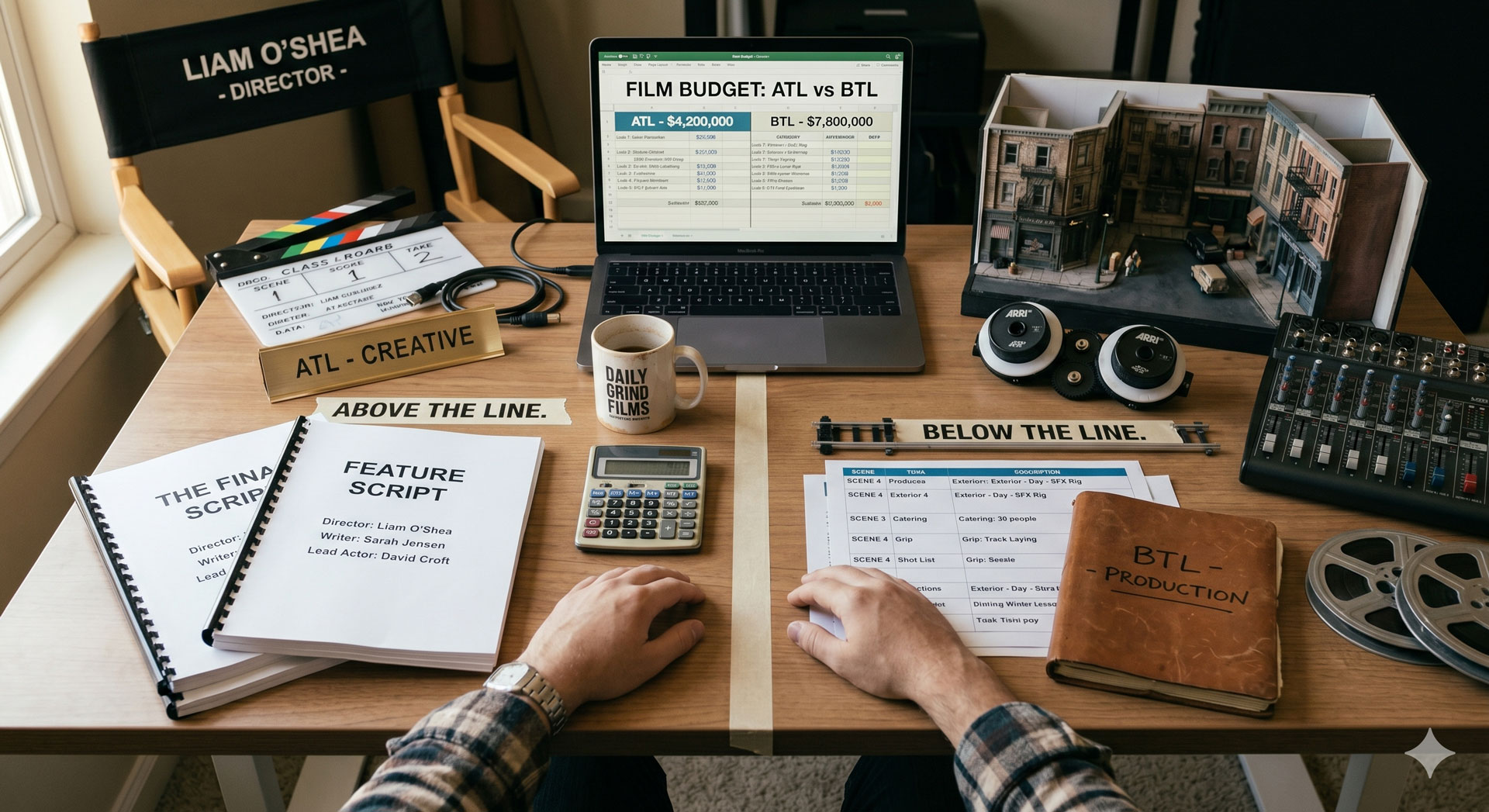
Above the line (ATL) and below the line (BTL) are the two halves every film budget splits into. ATL covers producers, director, writers, and principal cast — the creative leads whose deals are negotiated before prep begins. BTL covers everyone else who works on the production — camera, grip, electric, sound, art, wardrobe, locations, transport, catering, and the ADs who coordinate them. The split dictates how contracts are structured, when payments happen, and how the producer thinks about the budget.
The metaphor comes from old-school paper budgets that literally drew a line across the top sheet separating creative fees from production costs. The line is still there, now metaphorical, but the categories below and above it still structure how the industry negotiates.
The 50-word definition
Above the line (ATL) covers producers, director, writers, and principal cast — the creative team whose deals are set before production begins. Below the line (BTL) covers all other crew hired for the production. The distinction originates from paper-budget layouts and still structures contracts, payment timing, and approval hierarchies today.
Who's above the line
Four roles, always:
- Producers. Executive producer, producer, co-producer, line producer (sometimes BTL — see below). Everyone whose name goes on the contract before the script locks.
- Director. And any other director-level credit (e.g. "directed by" on episodic TV).
- Writers. Screenwriters, story credits, rewrite credits. Deferred rewrites sometimes get amended into ATL during production.
- Principal cast. Lead, co-lead, significant supporting roles. The line between "principal" and "day player" is negotiable and varies — generally, cast with contracts rather than day-rate bookings are ATL.
Some productions classify additional roles as ATL by contract: name-attached composers, name-attached DPs, celebrity hair and makeup department heads. When this happens, it's a deliberate negotiating concession to lock talent, not a standard practice.
Who's below the line
Everyone else. The full list is long, but the broad categories:
- Production department — 1st AD, 2nd AD, UPM (though the UPM is sometimes ATL on studio productions), production coordinator, APOC, PAs.
- Camera department — DP, operators, 1st AC, 2nd AC, DIT, data wrangler.
- Grip and electric (G&E) — gaffer, best boy electric, electricians, key grip, best boy grip, grips, dollies.
- Sound — production mixer, boom operator, utility sound.
- Art department — production designer, art director, set decorator, props master, construction coordinator, scenic, greens.
- Wardrobe — costume designer, supervisor, standbys, seamstresses.
- Hair and makeup — department heads and standby artists.
- Locations — location manager, assistants, PAs.
- Transport — captains, drivers, production assistants.
- Catering and craft services — chef, servers, craft PA.
- Stunts — stunt coordinator, stunt performers, safety.
- Effects — SFX supervisor and crew, VFX supervisor (sometimes).
Line producers are the notable gray area. On studio productions line producers are often ATL (they're making creative-budget calls); on indies they're often BTL (they're operational). When the role is unclear, the contract specifies — read the contract, don't guess.
Why the split exists
The division isn't arbitrary. It emerged for specific practical reasons.
ATL deals lock before prep
Producers, director, writers, and principal cast have to commit before the production can even begin prep. Cast availability drives schedule; director availability drives cast; writers lock the script the schedule is built from. ATL deals happen in weeks or months of pre-prep negotiation.
BTL crew are typically hired during prep itself, often in the last 2–6 weeks before the shoot. The negotiation is faster and simpler because the production already exists — the crew member is slotting into a known role on a known schedule.
ATL carries the project's financial risk
Producers often take deferred payments, back-end participation (percentage of net profit), or both. The director and lead cast frequently do the same. This is how indie productions get made at all — ATL takes financial risk in exchange for creative control and upside.
BTL crew almost never defer or participate in back-end. BTL is paid cash, on schedule, every week of production. A production that defers BTL is either in trouble or exploiting its crew.
Payment timing differs
ATL contracts frequently include pay-or-play clauses (the person gets paid whether the production happens or not, once signed), advance payments during prep, and milestone-based delivery. BTL is almost always weekly payroll during the run of employment, paid by a payroll service.
Approval authority differs
ATL decisions ripple through everything else. A director note changes the shot list, which changes the stripboard, which changes the DOOD, which changes the call sheet. ATL has the authority to trigger those cascades. BTL executes within them.
What the split looks like on different budgets
ATL as a percentage of total budget varies with scale:
| Budget tier | Typical ATL % | Typical BTL % | Typical Post % | Other % |
|---|---|---|---|---|
| Under $100k (shorts, micro-features) | 10–18% | 60–70% | 10–15% | 5–8% |
| $100k–$1M (indie features) | 18–28% | 55–65% | 10–15% | 5–8% |
| $1M–$5M (mid-budget) | 25–35% | 45–55% | 12–18% | 5–10% |
| $5M–$25M (studio features) | 30–45% | 35–45% | 15–20% | 8–12% |
| $25M+ (studio tentpoles) | 40–55% | 25–35% | 15–20% | 10–15% |
The pattern: as budgets grow, ATL grows fastest. A-list cast and directors command multi-million dollar fees; BTL crew rates rise too but at a much slower curve. On a $50M studio film, ATL can exceed BTL — the line has moved.
On indies, ATL is compressed because everyone takes scale or below. A $250k feature might pay the lead cast $30k combined; a $50M studio feature might pay a single lead $8M.
For a line-by-line indie budget at the $250k level, see indie film budget breakdown.
Where the line blurs
A few situations where the ATL/BTL distinction gets muddy:
Line producers. On studios they're often ATL; on indies often BTL. The line producer's actual job — running the budget and making cost-driven creative calls — sits on the boundary.
Writer-directors. Two credits, two fees, typically combined as a single ATL line for contract simplicity.
Producer-director hybrids. Same deal — one person, two roles, one combined ATL line unless the contract splits.
Name-attached BTL. A named DP, production designer, or composer whose deal is negotiated pre-prep by an agent at rates well above scale. Functionally ATL, accounted as BTL on most budgets. Some productions add a "BTL premium" line to track this.
Writers adding rewrites during production. Rewrite fees typically roll back into the writer ATL line but sometimes get split into their own category mid-production if the rewrite is significant.
The line in budget software
The ATL/BTL structure is baked into every major film budgeting tool. Movie Magic Budgeting, Hot Budget, Showbiz Budgeting, and Production Slate's budget feature all organize the chart-of-accounts around the same top-level categories:
- 01-series: ATL (producer, director, writer, cast)
- 02-series: BTL production (ADs, UPM, coordinator)
- 03-series: BTL art department
- 04-series: BTL camera
- 05-series: BTL G&E
- 06-series: BTL sound
- 07-series: BTL wardrobe / HMU
- 08-series: BTL locations
- 09-series: BTL transport / catering / office
- 10-series: Post
- 11-series: Other (insurance, legal, contingency, financing)
The numbers aren't universal but the grouping is. If you're migrating budgets between tools, expect the ATL and BTL sections to translate cleanly — the trickier part is the BTL sub-groupings where tools differ slightly.
For software comparisons, see best film budgeting software. For specific migration considerations, Movie Magic Budgeting alternatives covers the data paths.
When the split matters in practice
Three moments during a production where ATL vs BTL changes what you do:
Negotiation and contracts. ATL deals are longer, more complex, and signed months before BTL deals. Never negotiate a BTL deal on the same template as an ATL deal; the structures are fundamentally different.
Cash flow planning. ATL advances happen during prep. BTL payroll happens weekly during production. Post payments happen during post. A line producer who treats all three as one lump is setting up a cash crunch.
Budget cuts. The cut order when a budget has to come down: contingency first, then post (via deferred delivery), then BTL rentals (camera, G&E, vehicles), then BTL crew rates, then ATL last. ATL cuts burn relationships with agents and lock future productions out of name talent.
Common misconceptions
"ATL is the important people, BTL is everyone else." Wrong framing. Both are essential. ATL locks the creative vision; BTL executes it. A production can't function with one and not the other.
"ATL always earns more than BTL per person." Usually true on studio films, often not on indies. An indie DP with a rate card might out-earn the writer-director who's deferred their fee.
"Line producers are ATL." Sometimes. Read the contract.
"The line is a legal distinction." It isn't. ATL and BTL are accounting conventions, not legal categories. Guild jurisdictions (WGA for writers, DGA for directors, SAG for actors) create legal distinctions, but those don't map cleanly to the ATL/BTL split.
Next step
If you're building a budget, use the ATL/BTL structure from day one — even a $25k short film benefits from the accounting clarity. For a full line-by-line walkthrough at the $250k level, see indie film budget breakdown. For the full build process from script to locked budget, how to build a film budget walks through each phase.
For software that organizes your budget around the standard ATL/BTL chart of accounts and tracks estimates vs actuals in real time, Production Slate's budget feature is the fastest way to get a shareable, line-producer-ready budget off the ground.
What percentage of a film budget is above the line?
On studio features, above-the-line costs commonly run 20-35% of the total budget, and star salaries can push it higher. Independent films usually sit lower, because cast and director fees are negotiated down or partly deferred.
For a $1M indie feature, a typical shape looks like:
- Above the line: 15-25% ($150k-$250k) - story rights, writer, director, producer fees, and principal cast
- Production: 50-60% - crew, camera and G&E packages, locations, art department, transport, catering, insurance
- Post-production: 15-20% - edit, color, sound mix, music licensing, deliverables
- Contingency: 10% held on top of everything above
If the above-the-line share climbs past roughly 35% at this budget level, the money on screen suffers - the usual fixes are deferments tied to backend points, or recasting the budget around a smaller name. Financiers read the ATL/BTL split as a proxy for where a production's priorities sit.
Written by Production Slate · Production Slate