Film Budget Contingency Explained (The 10% Line, What It Covers)
Contingency is the budget's admission that the plan will be wrong somewhere — the only question is whether the line is big enough and who controls it.
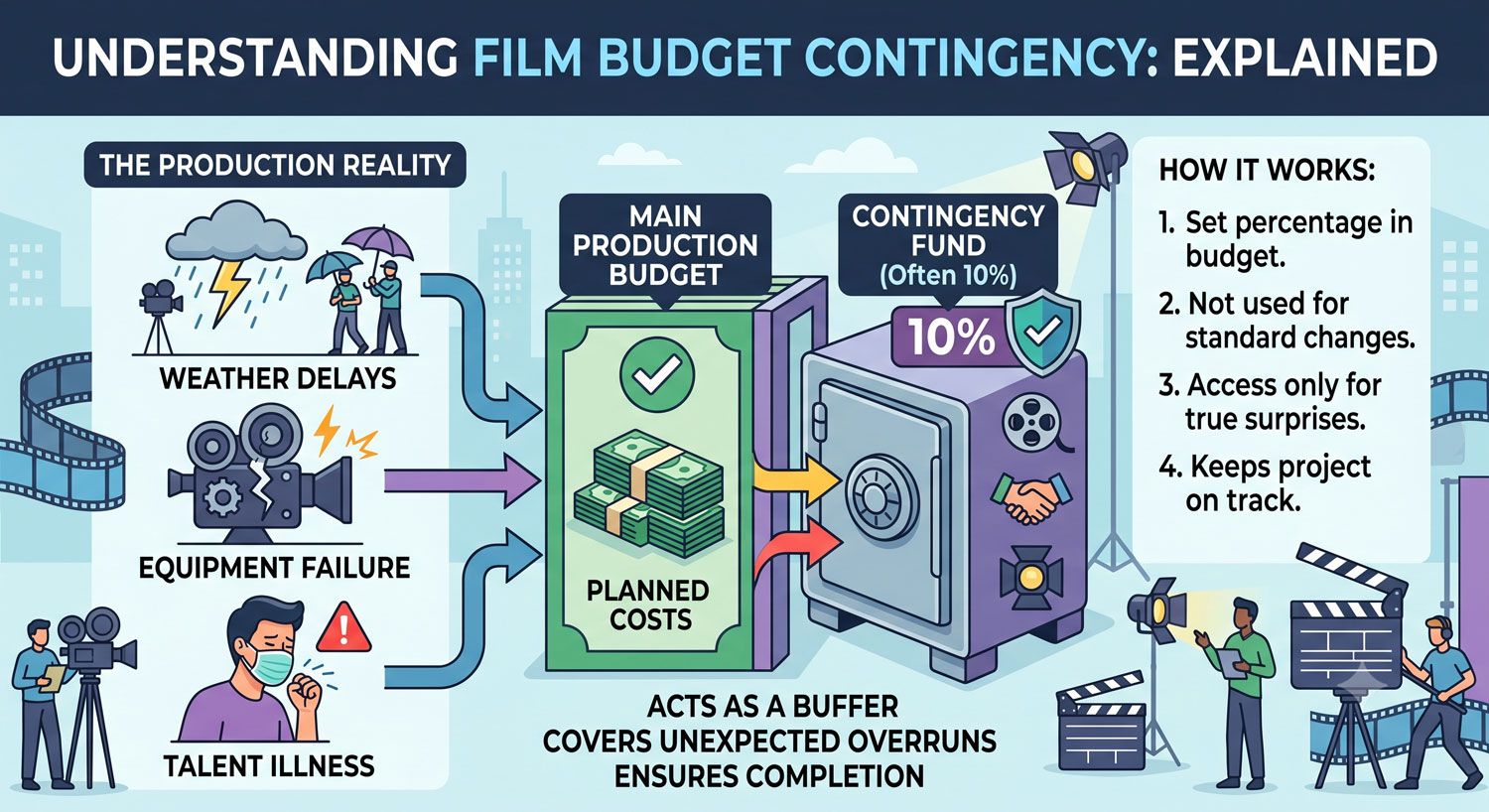
Film Budget Contingency Explained (The 10% Line, What It Covers)
Contingency is a reserve line built into a film budget to absorb costs nobody planned for — a location falls through and a replacement costs more, a piece of equipment breaks, a weather day pushes the schedule and triggers a company move that wasn't in the original plan. It's usually expressed as a percentage of the total budget (commonly discussed in the industry as being around 10%, though the right number depends heavily on the production's risk profile) and sits as its own line, separate from every department's working budget.
Contingency isn't a slush fund and it isn't padding. A well-run production treats it as a controlled reserve with its own approval process — the opposite of a bucket that quietly absorbs sloppy budgeting in every department.
What contingency actually covers
Contingency exists for costs that are genuinely unplanned, not costs that were underbudgeted from the start. The distinction matters because it determines whether a department head can reasonably expect contingency to bail them out:
- Unexpected weather — a rain day that pushes an exterior scene and forces schedule changes, extra crew days, or a location re-book.
- Equipment failure or loss — camera or lighting gear that breaks mid-shoot and needs emergency replacement or rental.
- Location changes — a location falls through late, or a permit issue forces a last-minute substitute at a higher rate.
- Genuine scope surprises — a practical effect that turns out to need more setup time than planned, an extra shoot day that becomes unavoidable.
What contingency should not routinely cover: a department that was simply underbudgeted in prep (that's a budgeting error, not an unplanned cost), or overtime that results from a schedule everyone knew was optimistic when it was built. Using contingency to paper over predictable underbudgeting hides the real problem instead of fixing it, and it guarantees the reserve runs out before it's needed for something genuinely unplanned.
How much contingency is enough
There's no single correct percentage — the right contingency size depends on the production's risk profile, not a rule of thumb. Factors that push contingency higher:
- Location risk — a lot of exterior work, remote locations, or weather-dependent scheduling all raise the odds of unplanned cost.
- Schedule tightness — a schedule with no built-in buffer days is more likely to need contingency to absorb a slip.
- New or unproven elements — practical effects, stunts, animals, minors, or any department the production hasn't worked with before carries more unknowns.
- Production experience — a first-time producer or a crew that hasn't worked together before tends to hit more unplanned costs than an experienced team on familiar terrain.
A tightly controlled studio-backed production with a proven crew and a conservative schedule can run leaner on contingency than a first-time indie shooting mostly exteriors on a schedule with no slack. Sizing contingency honestly — rather than defaulting to whatever percentage looks acceptable to a financier — is one of the more important judgment calls in the whole budget, alongside getting the above-the-line and below-the-line split right in the first place.
Who controls the contingency line
On a well-run production, contingency isn't accessible the same way a department's working budget is. Typical control structure:
- Department heads can spend within their approved line without additional sign-off (within normal limits).
- Contingency draws require producer or line producer approval — usually a specific, documented request explaining what happened and why it wasn't foreseeable, reviewed against the hot cost report to confirm the rest of the budget is still tracking.
- Large draws may require financier or executive producer sign-off, particularly on projects with outside investment, since a big contingency draw changes the risk profile of the whole picture.
This layered approval isn't bureaucracy for its own sake — it's what keeps contingency available for the emergency it's meant for, instead of being nibbled away early in the shoot on smaller issues that should have been absorbed by better prep.
When contingency isn't enough
Contingency is a buffer, not insurance — it has a hard limit, and productions do exhaust it, usually from a combination of a few of the risk factors above compounding at once (a weather-heavy shoot that also runs into equipment trouble and a location change, for example). When contingency runs out mid-shoot, the options narrow fast: cut scope, extend financing, or absorb the overage by cutting corners elsewhere in the budget — none of which are good options, which is exactly why sizing contingency honestly at the start matters more than it might seem during a hopeful prep period.
Tracking contingency usage against the hot cost report throughout the shoot — not just noticing it's gone at wrap — is what gives a production the chance to react while there's still time to adjust the plan, rather than discovering the exhausted reserve only when the next unplanned cost has nowhere to go.
Build contingency in from the start, not as an afterthought
Contingency only works as a real safety net if it's sized deliberately and tracked as its own line from day one. For a worked example of exactly where a contingency line sits inside a real production budget, see our indie film budget breakdown. To keep contingency usage visible alongside every other line as the shoot progresses, Production Slate's budget tool tracks actuals against budget in real time, so a contingency draw shows up the moment it happens instead of at the final cost report.
Written by Production Slate · Production Slate