Location Agreement Basics (What a Release Covers)
A location agreement is the paperwork that turns "sure, come film here" into something you can actually rely on. Here's what it typically covers — verify locally.
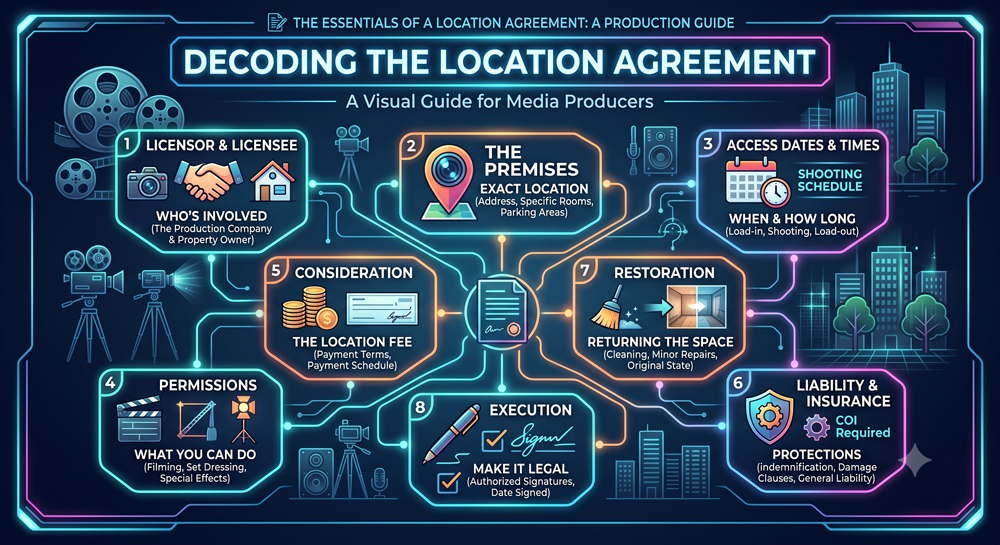
Location Agreement Basics (What a Location Release Actually Covers)
A location agreement is the written contract between a production and a property owner that spells out exactly what the crew is allowed to do at a location, when, for how long, and for how much. A friendly verbal "yeah, come shoot here" is not a location agreement — it's the reason productions get shut down mid-day when a neighbor complains and the owner suddenly isn't sure what they agreed to.
This is a general overview of what these agreements typically include, not legal advice. Location law, permit requirements, and standard terms vary by city, state, and country, and insurance requirements vary by production type — always verify the specifics with a local entertainment attorney or your production insurance broker before you sign anything or send a crew.
The 50-word definition
A location agreement (or location release) is a signed contract between a production and a property owner or manager granting permission to film, specifying dates, times, areas of access, fees, insurance requirements, and restoration obligations. It protects both sides and is separate from any city film permit that may also be required.
What a location agreement typically covers
- Parties and property — legal name of the owner/manager and the exact address and areas of the property covered (not just "the house," but which rooms, yard, driveway, roof access, etc.)
- Dates and times — specific shoot dates plus prep and strike days, since load-in and load-out often need separate access windows than the actual shoot day
- Location fee and payment terms — flat day rate, hourly rate, or a negotiated trade, and when payment is due (many owners expect same-day payment)
- Scope of use — what the crew can actually do: move furniture, paint a wall, remove fixtures, park trucks on the lawn, use a generator, fly a drone. Anything not explicitly permitted should be assumed off-limits
- Restoration clause — the obligation to return the space to its original condition, and who pays for damage beyond normal wear
- Cancellation and weather terms — what happens if the shoot is rescheduled or canceled, and whether a deposit is refundable
- Insurance and indemnification — most owners and many cities require a certificate of insurance naming the property owner as additionally insured; production insurance brokers issue these on request
- Right to use footage — confirms the production owns footage shot at the location and can use it commercially, which matters more than owners often expect for a private residence
- Exclusivity/no-compete — occasionally used for locations tied to a specific brand or business, restricting how the footage can be used afterward
Why the verbal agreement isn't enough
A written agreement matters even when the owner is a friend or family member, because it's the document that actually protects everyone if something unexpected happens: a slip-and-fall, a damaged floor, a neighbor's noise complaint, or a dispute over whether the crew was allowed to park where they parked. Without it, a friendly location can turn adversarial fast, and the production has no paper trail to fall back on.
It's also the document a city permit office or an insurance carrier may ask to see before issuing a permit or a certificate — treat it as a prerequisite step in your location scouting checklist, not paperwork to chase after the location is already locked.
How this fits into the schedule
Get agreements signed before a location goes on the one-liner schedule as confirmed — a verbally-promised location that falls through mid-prep is one of the most common causes of a schedule rewrite. If a location is only "likely," keep it as a placeholder and have a backup in mind, especially for anything involving a company move that depends on both locations being locked.
The same logic that applies to locations applies to people — cast and background also sign releases, covered in talent release form basics, and both documents get filed the same way: before the shoot, not after.
Who signs it, and when
The location agreement is typically signed by the locations manager (or a producer on a smaller crew) and the legal owner of the property — not a tenant, employee, or family member unless they have documented authority to grant access. For a rented apartment or a leased commercial space, that usually means confirming with the landlord, not just the person living or working there, since a lease can restrict commercial filming even when the occupant is happy to say yes.
Get it signed as early in prep as the location is genuinely confirmed. A common failure mode is treating a signature as a formality to collect the morning of the shoot — by then there's no leverage left if the owner wants to renegotiate the fee, restrict access to a room, or back out entirely because a family member objected overnight. Building the signature into the same step as the tech scout, once department heads have actually confirmed what access they need, avoids re-opening the agreement later for scope the crew forgot to ask about.
When budget is tight
Not every location needs a paid fee — trades, favors, and free access from friends' properties are common on low-budget indies, and a written agreement matters just as much (arguably more) in those cases since there's no invoice creating a paper trail. See how to find film locations on a low budget for sourcing tactics that still need this paperwork behind them.
Keep location documents attached to the location, not scattered in email
Signed agreements, insurance certificates, and permit numbers are easy to lose track of across a shoot with a dozen locations. Production Slate's locations module keeps contact info, notes, and status attached to each location so the person running the shoot day can confirm what's actually been signed off before the crew shows up.
Written by Production Slate · Production Slate